Best Grow Lights for Seedlings (2026 Picks)
The best grow lights for seedlings in 2026—with real PPFD targets, wattage traps to avoid, and picks for every budget. No fluff.
Key Takeaways
- The Barrina T5 LED 4-pack (~$35) plus a $10 outlet timer is the best grow light setup for most seedling growers in 2026.
- South-facing windows in winter deliver 800–2,000 lux for only 4–6 hours — seedlings need 2,500–5,000+ lux for 14–16 hours, making a dedicated grow light non-negotiable.
- Tropical houseplant cuttings like pothos and monstera only need 100–200 µmol/m²/s PPFD — half the intensity of vegetable seedlings — so don't overbuy for propagation.
- Always buy by actual input wattage and published PPFD, not 'equivalent' wattage marketing claims; aim for 200–400 µmol/m²/s PPFD for vegetable seedlings.
- Leggy seedlings are almost always caused by the light hanging too high — lower your fixture 2 inches before spending money on a new one.
- Use a phased timer schedule: 16 hours at germination, 14 hours at true-leaf stage, 12 hours during the two-week hardening-off period before transplant.
Why Most Seedlings Fail Indoors (It's the Light)
The single best grow light for seedlings in 2026 is the Barrina T5 LED Grow Light Strips 4-pack paired with a $10 outlet timer. That combo costs under $50 and outperforms windowsill growing by a factor of three on every metric that matters. If you propagate tropical houseplants — pothos, monstera, philodendron — a standard LED shop light at 4,000–5,000K hung 4–6 inches overhead does the job for under $25.
Now here's why most people still fail, and why a grow light isn't optional.
The Windowsill Problem — Quantified
A south-facing window in winter delivers roughly 800–2,000 lux for 4–6 hours per day. Seedlings need 2,500–5,000+ lux for 14–16 hours. That's not a small gap. It's an order of magnitude in total daily light integral (DLI). According to University of Maryland Extension, most indoor light environments deliver less than 10% of what outdoor growing conditions provide — even near a bright window in summer.
When light falls short, seedlings etiolate. The plant stretches toward any available light source, producing elongated, weak internodes and thin stems. Once a seedling etiolates badly, it rarely recovers full structural strength. The window isn't a grow light. It never was.
Houseplant Seedlings vs. Vegetable Seedlings: Different Needs
This distinction matters, and almost no one makes it clearly. Vegetable seedlings — tomatoes, peppers, squash — need 300–400 µmol/m²/s PPFD (Photosynthetic Photon Flux Density) to grow stocky and strong. Tropical houseplant cuttings like pothos and monstera root well at 100–200 µmol/m²/s. That's roughly half the intensity.
If you're propagating houseplants, you don't need a $150 fixture. Don't overbuy. A single Barrina T5 LED Grow Light Strip or a basic shop light is genuinely sufficient. If you're starting tomatoes or peppers from seed, step up to a full 4-foot fixture with PPFD specs on the label.
LED vs. Fluorescent Grow Lights for Seedlings
For anyone buying new equipment in 2026: buy LED. Full stop. The price gap between LED and T5 HO (High Output) fluorescent has closed substantially, and the running-cost math favors LED over any horizon longer than two seasons. That said, fluorescent still makes sense in specific situations — so let's be precise about when.
When T5 HO Fluorescent Still Makes Sense
T5 HO (High Output) fluorescent tubes are proven technology. They produce a broad, even light spread and work well for seedlings. The SunBlaster T5HO Strip Light with NanoTech Reflector is the strongest argument for keeping fluorescent in the conversation — the NanoTech Reflector recovers scattered light and boosts usable output by up to 30% without adding a single watt.
But fluorescent has real costs. T5 HO fluorescent tubes degrade after 10,000–15,000 hours and need annual replacement in heavy-use setups. Surface temperatures at the bulb run 95–110°F, which dries out a 72-cell seed tray noticeably faster than LED. The U.S. Department of Energy notes that LED equivalents use 25–30% less energy than T5 fluorescent for the same lumen output.
Fluorescent makes sense if you already own a fixture and only need replacement bulbs, or if you're running a cold basement setup where the extra heat actually helps germination temperatures stay above 65°F.
Why Most Growers Are Switching to LED
LED panels and strips run cooler — surface temps of 60–75°F versus 95–110°F for T5 HO fluorescent tubes. Lifespan is 40,000–50,000 hours versus 10,000–15,000 for fluorescent. Electricity draw per equivalent light output is lower. And the meaningful spec — PPF/PPFD (Photosynthetic Photon Flux Density) at canopy level — is now published by most serious LED manufacturers, making comparison shopping actually possible.
When shopping for full-spectrum LEDs, look for coverage across the 400–700nm range with blue peaks at 440–460nm and red peaks at 630–660nm. White-light LEDs in the 4,000–6,500K range cover this adequately for seedlings without the complexity of blurple grow panels.
What to Look for Before You Buy
PPF / PPFD: The Only Light Metric That Actually Matters
Lumens measure light for human eyes. PPF/PPFD — Photosynthetic Photon Flux Density, measured in µmol/m²/s — measures light for plants. They are not interchangeable. A light rated at 5,000 lumens tells you almost nothing about plant performance. PPF measures total photons emitted by the fixture; PPFD measures photons actually arriving at the canopy surface.
Target PPFD ranges for 2026 purchases:
- Tropical houseplant propagation (pothos, monstera, philodendron cuttings): 100–200 µmol/m²/s
- General seedlings and low-demand starts: 200–300 µmol/m²/s
- Vegetable seedlings (tomatoes, peppers, brassicas): 300–400 µmol/m²/s
If a product listing doesn't publish PPF or PPFD data, that's a red flag. The manufacturer either hasn't measured it or doesn't want you to know. Purdue University's horticulture department has published extensive guidance on DLI and PPFD targets for controlled-environment agriculture — the seedling ranges above align with their baseline recommendations.
True Watts vs. 'Equivalent' Wattage — Don't Get Fooled
This is the most common buying mistake. A light marketed as "1000W equivalent" drawing 45W actual covers roughly 2–3 square feet of seedling trays. Not a 4×4 space. Not even close.
The rule: aim for 20–40 actual draw watts per square foot for vegetable seedlings. Always find the "input wattage" or "actual power draw" in the spec sheet — not the equivalent number. If the listing only shows the inflated equivalent, keep scrolling.
Coverage Area, Color Temperature, and Budget Tiers
A single standard 1020 seed tray (roughly 10"×20") fits under a 2-foot strip light. A 4-foot fixture covers two trays side by side. If you're running three or more trays simultaneously, a cart system or multi-shelf setup is worth the higher upfront cost.
Color temperature for seedlings: use cool white in the 5,000–6,500K range. Warm white (2,700K) is weighted toward the red spectrum used for flowering and fruit set — it's the wrong tool for germination and early vegetative growth.
Budget breakdown as of April 2026:
- $15–$40: Barrina T5 LED Grow Light Strips, basic LED shop lights
- $50–$120: SunBlaster T5HO Strip Light with NanoTech Reflector, Ferry-Morse LED kit, Dynamo LED
- $150+: Burpee LED Two-Tier Cart Grow Light, dedicated commercial-grade strip systems
Best Grow Lights for Seedlings: Our Top Picks
| Light | Type | Actual Draw | Best For | Price (Apr 2026) |
|---|---|---|---|---|
| Barrina T5 LED Grow Light Strips 4-Pack | LED Strip | ~36W (4-pack) | Budget seed starting, single shelf | ~$35 |
| SunBlaster T5HO Strip Light with NanoTech Reflector | T5 HO Fluorescent | 54W (4-foot) | Serious seed starting, fluorescent preference | ~$75–$90 |
| Burpee LED Two-Tier Cart Grow Light | LED Panel/Cart | ~60–80W | High-volume starts, small apartments | ~$180–$220 |
| LED Utility Shop Light (4-ft, 5000K) | LED Shop Light | ~40–50W | DIY, houseplant propagation | ~$20–$28 |
| Ferry-Morse LED Grow Light | LED | ~30–45W | Beginners wanting a turnkey kit | ~$65–$85 |
| Dynamo LED Grow Light | LED | ~40–55W | Mid-range, adjustable spectrum | ~$80–$100 |
Setup Basics That Multiply Your Results
Height and Duration: The Two Dials That Matter Most
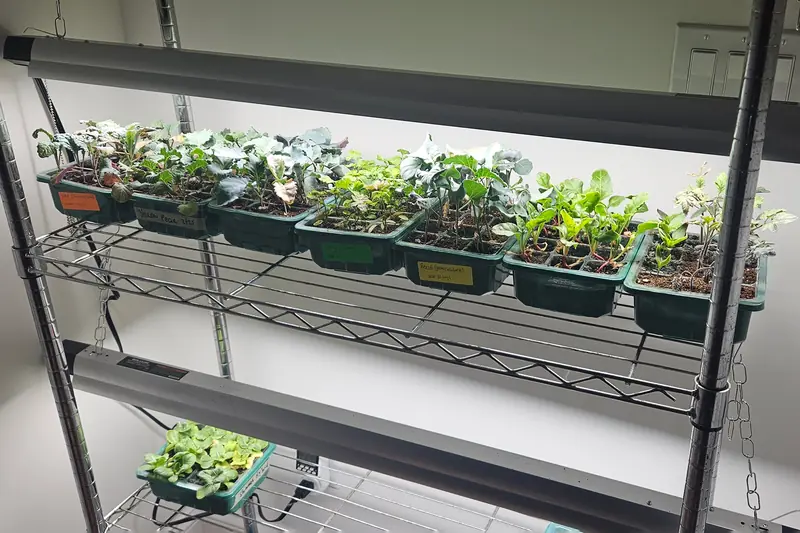
Even a great light underperforms when hung at the wrong height. The Barrina T5 LED Grow Light Strips work best at 2–4 inches above seedling canopy for vegetable starts. The SunBlaster T5HO Strip Light with NanoTech Reflector can run 4–6 inches due to the reflector's efficiency gain. Panel-style lights like the Burpee LED Two-Tier Cart Grow Light typically specify optimal height in the manual — follow it.
Duration matters as much as intensity. Seedlings need 14–16 hours of light per day. A $10 mechanical outlet timer removes the margin for error entirely. Set it and forget it. Without a timer, inconsistent photoperiods stress seedlings and slow germination rates.
Raising the Light as Seedlings Grow
As seedlings develop true leaves and gain height, raise the fixture incrementally to maintain consistent PPFD at canopy level. Chains, zip ties on S-hooks, or adjustable ratchet hangers all work. The goal is to keep the top of the seedling at the same distance from the light throughout the growing cycle — not to keep the fixture at a fixed height from the shelf.
Heat, Humidity, and What Grow Lights Actually Affect
T5 HO fluorescent tubes add meaningful heat load — useful in cold basements, a liability in warm rooms. If ambient temps already sit above 72°F, LED is the unambiguous choice. Soil moisture also responds to light choice: fluorescent fixtures dry out the top inch of growing medium noticeably faster. Check soil moisture daily under T5 HO setups; every other day is usually sufficient under LED strips.
Frequently Asked Questions
Can I use a regular LED shop light for seedlings?
Yes, with caveats. A 4-foot LED shop light in the 4,000–5,000K range hung 3–5 inches above the canopy delivers adequate PPFD for houseplant propagation and low-demand seedlings. For tomatoes and peppers, a dedicated fixture with published PPF/PPFD specs will outperform a generic shop light — but a shop light is vastly better than any windowsill.
How many hours should grow lights run for seedlings?
14–16 hours per day for most vegetable seedlings. Tropical houseplant cuttings can root at 12–14 hours. Use a timer. Running lights for 20+ hours does not accelerate growth and shortens fixture lifespan without meaningful benefit.
Do seedlings need a dark period?
Yes. Most plants require at least 6–8 hours of darkness for normal metabolic processes. Running grow lights continuously (24 hours) causes physiological stress in most seedling varieties. The exception is lettuce and some herbs, which tolerate near-continuous light, but even then a short dark period is generally recommended.
What's the difference between PPF and PPFD?
PPF (Photosynthetic Photon Flux) measures total photons emitted by a light source per second, in µmol/s. PPFD (Photosynthetic Photon Flux Density) measures photons arriving at a specific point on the canopy surface, in µmol/m²/s. PPF describes the fixture; PPFD describes what plants actually receive. For seedling growing decisions, PPFD at your specified hang height is the number that matters most.
The Bottom Line
For most home growers starting seeds in 2026, the decision tree is short. Buy the Barrina T5 LED Grow Light Strips 4-pack and a timer if you're budget-conscious. Step up to the SunBlaster T5HO Strip Light with NanoTech Reflector if you prefer fluorescent or are running a cold basement setup. Invest in the Burpee LED Two-Tier Cart Grow Light if you're starting 200+ cells per season and need a self-contained system.
Ignore watt-equivalent marketing, verify PPF/PPFD specs before buying, and put a timer on every fixture. Those three habits eliminate the majority of indoor seed-starting failures before a single seed goes in the tray.
Frequently Asked Questions
Can I use a regular LED bulb as a grow light for seedlings?
Not effectively. Standard household LED bulbs lack the intensity (PPFD) and spectral balance needed for seedling development. A regular bulb will keep a seedling alive but won't deliver the 200–400 µmol/m²/s PPFD required for compact, healthy growth. The light is too diffuse and the spectrum too narrow. Use a dedicated grow strip or shop light instead.
How do I know if my seedlings are getting too much light?
Watch for bleached or white leaf tips, inward-curling leaves, and soil that dries within a few hours of watering. These are signs of either excessive intensity or the fixture hanging too close. Raise the light 2 inches and reassess before reducing timer hours. Over-lighting is far less common than under-lighting, but it happens — especially with high-output LED panels hung at 1–2 inches.
Do houseplant cuttings need as much light as vegetable seedlings?
No — and this distinction matters for your wallet. Tropical houseplant cuttings like pothos, monstera, and philodendron root well at 100–200 µmol/m²/s PPFD, roughly half what a tomato seedling needs. A single Barrina strip or a $25 shop light at 6 inches overhead is sufficient for houseplant propagation. You don't need a premium fixture for cuttings.
How long do LED grow lights last compared to T5 fluorescent?
Quality LED grow lights are rated for 40,000–50,000 hours, which translates to 10+ years at 14 hours per day before meaningful lumen depreciation. T5 fluorescent tubes typically need replacement every 12–18 months of heavy seasonal use — roughly every 5,000–8,000 hours in a seed-starting context. Over a 3–5 year horizon, LED wins on total cost of ownership.
How many hours of light do seedlings need per day?
Use 16 hours during germination and the cotyledon stage, drop to 14 hours once true leaves appear, and reduce to 12 hours in the two weeks before outdoor transplant to begin hardening off. Don't run lights 24 hours — plants need a dark period for metabolic recovery, and continuous light causes stress symptoms in most seedling species.
Is a grow light cart worth the money for home seed starting?
Yes, but only if you're starting more than 4 trays per season or have no dedicated shelf or rack space to hang strips from. The Burpee LED Two-Tier Cart earns its $180–$220 price tag in those scenarios — it's mobile, self-contained, and purpose-built. For 1–2 trays, two Barrina 4-packs on a wire rack accomplish the same result for $80–$100 less.