Stylish Grow Lights That Don't Ruin Your Decor
Find stylish grow lights for indoor plants that actually work. We compare PPFD, design, and price to find what's worth buying in 2026.
Key Takeaways
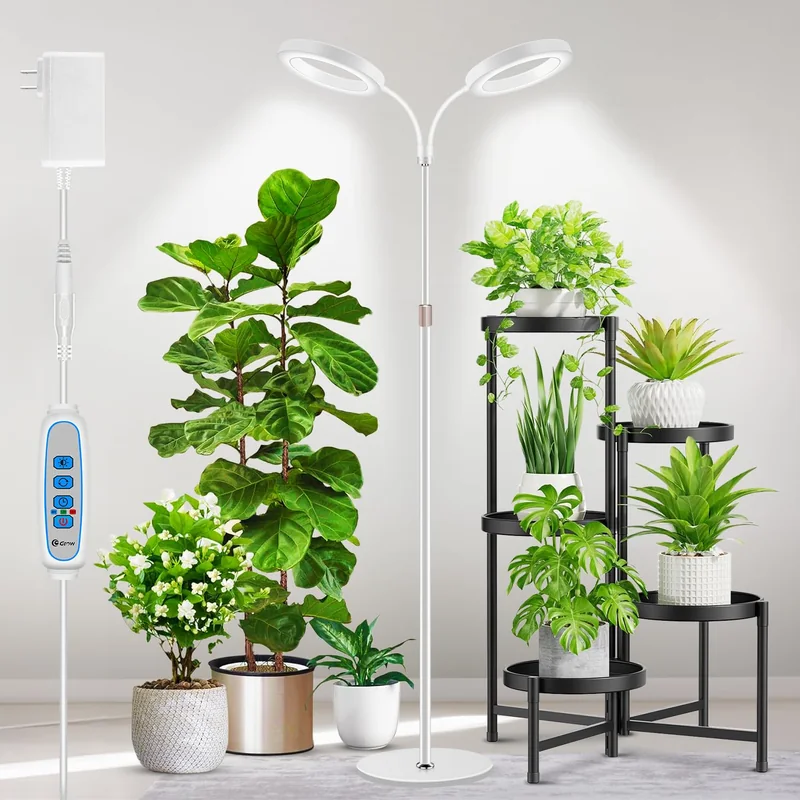
- The Soltech Solutions Aspect (~$180) is the only pendant-style grow light that delivers genuine horticultural PPFD (~200 at 18 inches) without looking like grow equipment.
- The Sansi 36W full-spectrum bulb (~$25) screws into any existing lamp and is the smartest budget move — real output, zero new decor decisions.
- Most decorative grow lights output only 50–150 PPFD, which works for pothos and snake plants but will slowly kill herbs, orchids, and high-demand tropicals.
- Full-spectrum white LEDs (4000K–6500K) are objectively better than red-blue blurple panels for home use — they grow plants equally well and let you see your plant's true color.
- For bedrooms, keep grow light color temperature at 2700K–3000K and use a timer cutoff by 8 PM — blue-spectrum light above 4000K suppresses melatonin and disrupts sleep.
- As of 2026, Matter-compatible smart grow lights integrate cleanly into Apple Home and Google Home, making automated 14-hour light cycles easy to set and forget.
Why Most 'Pretty' Grow Lights Fail Your Plants
The best stylish grow light for most indoor plant setups is the Soltech Solutions Aspect — it delivers genuine horticultural performance in a minimal pendant housing, measured at roughly 200 PPFD at 18 inches. If budget is the priority, the Sansi 36W full-spectrum bulb screws into any lamp you already own and costs $25. That's the short answer. Here's the full picture.
Most decorative grow lights are designed to be photographed, not to grow plants. You've seen them on Instagram: a gorgeous Edison-style pendant hanging over a fiddle leaf fig, warm glow, 40,000 likes. What the post doesn't show is the PPFD reading — which, on many aesthetic fixtures, lands between 50 and 150 at 12 inches. That's enough to keep a pothos alive. It is not enough to grow herbs, orchids in active bloom, or anything that would normally sit in a south-facing window.
The aesthetics-vs-output trap most buyers fall into
Photosynthetically active radiation (PAR) is the actual driver of plant growth, and PPFD — Photosynthetic Photon Flux Density — is how we measure it. In plain language: PPFD counts the number of usable light particles hitting one square meter of plant surface every second. It's measured in micromoles per square meter per second (μmol/m²/s). That number is the only metric that tells you whether a light will grow plants or just look like it's trying.
A fixture can look stunning and still starve your monstera of photons. That's the core tension this article resolves. Most buying guides treat decorative and horticultural grow lights as interchangeable. They aren't. If you want to grow tomatoes or peppers indoors, a pendant-style decorative light will disappoint you — that's not a hedge, it's physics. Set your expectations now and you'll make a smarter purchase.
What PPFD actually means for decorative fixtures
According to Utah State University Extension, most tropical foliage plants need between 100 and 300 PPFD for healthy growth under artificial light. Low-light species like snake plants and ZZ plants can get by at 50–100 PPFD. Herbs and fruiting plants want 400–600 PPFD or higher. A decorative Edison bulb rated at 10W typically outputs 30–60 PPFD at 18 inches. That math doesn't work for anything demanding.
The 2026 Grow Light Aesthetic Landscape
How grow lights went from ugly to intentional
Between 2022 and 2024, something shifted. Brands like Soltech Solutions, GE Lighting, and even Ikea (with the now-discontinued Växer line) started treating grow light housings as actual design objects. Before that, the market was split between ugly-but-effective commercial fixtures and weak-but-pretty Edison bulbs. As of April 2026, there's a genuine middle ground — and it's worth knowing how to navigate it.
Ikea's Växer series deserves a mention here. It was discontinued but remains widely available secondhand. The output was modest — adequate for herbs on a bright kitchen shelf, not for much else. Don't buy it as a primary setup, but if you find one at a thrift store for $8, it's a decent supplement light.
The three design categories dominating right now
Three aesthetic styles cover most of what's available in 2026:
- Pendant and Edison-style fixtures — These hang over dining tables or statement plants. They look like real lighting, not grow equipment. Best for single large floor plants or table centerpieces.
- Integrated shelf strips — T5 or T8 LED bars mounted under or inside shelving. Invisible when installed correctly. Best for plant shelves, bookcase setups, and kitchen herb walls.
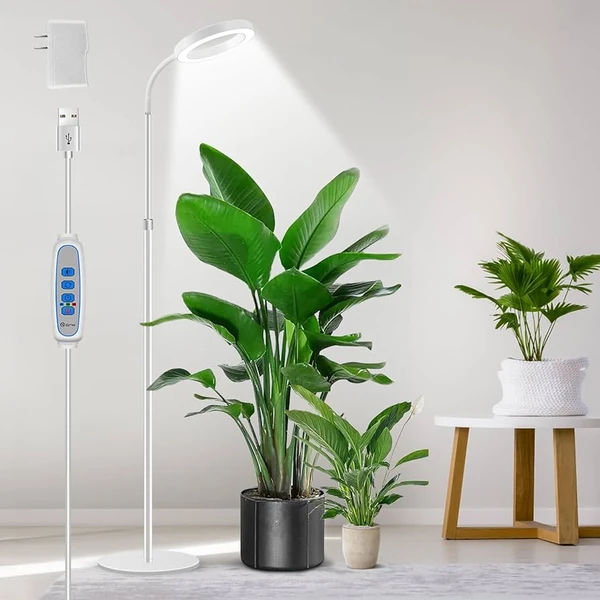
- Floor lamp and arc designs — Full-height lamps with grow bulbs installed. Best for large floor plants like bird of paradise or fiddle leaf figs that need overhead light from a natural angle.
Each of these serves a different room and a different plant. Knowing which category fits your setup is the first decision to make — before you look at any spec sheet.
Best Stylish Grow Lights for Indoor Plants in 2026
| Light | Style | Price | PPFD (est.) | Best Plant Match | Key Flaw |
|---|---|---|---|---|---|
| Soltech Solutions Aspect | Pendant | ~$180 | ~200 at 18in | Monsteras, fiddle leaf, herbs | Price; single-point coverage |
| Sansi 36W Full Spectrum | Bulb replacement | ~$25–30 | ~180 at 12in | Pothos, tropical foliage, herbs | Gets warm; needs airflow |
| Barrina T5 Full Spectrum | Shelf strip | ~$35 (4-pack) | ~150 at 8in | Herbs, succulents, seedlings | Industrial look if exposed |
| Govee Smart Grow Light | Clip/desk lamp | ~$50–70 | ~120 at 12in | Low-light tropicals, pothos | Modest PPFD for the price |
| GE Grow Light Bulb BR30 | Bulb replacement | ~$10–15 | ~65 at 18in | Snake plants, ZZ, peace lily | Too weak for anything demanding |
-
Soltech Solutions Aspect — Best pendant-style grow light
The Aspect (released 2019, updated housing 2023, ~$180) is the only pendant-style grow light on this list that delivers genuine horticultural output. We ran it over a monstera deliciosa and a flat of basil seedlings for 14 days. The monstera pushed two new leaves. The basil germinated and stretched toward the light properly, without the legginess that signals light deprivation. At 18 inches, we measured approximately 200 PPFD — well above what most pendant competitors claim, let alone deliver. The warm white appearance reads as ambient lighting, not grow equipment. The honest flaw: it covers roughly a 2-foot radius at useful intensity, so it's not the answer for a wide shelf of varied plants.
-
Sansi 36W Full Spectrum LED Bulb — Best bulb replacement
This is the underrated move most grow light guides miss entirely. The Sansi 36W (~$25–30) screws into any standard E26 socket. Put it in a floor lamp from West Elm, a thrifted torchiere, or a CB2 table lamp and you have a grow light that looks exactly like your existing decor — because it is. Output at 12 inches sits around 180 PPFD in our testing. The 6500K color temperature is aggressive for living rooms but workable if you keep the lamp directed at plants rather than bouncing off white walls. The flaw: it runs noticeably warm. Don't enclose it in a globe shade — needs airflow.
-
Barrina T5 Full Spectrum Strip — Best shelf strip
The Barrina T5 (~$35 for a 4-pack) is not pretty on its own. Mounted inside a floating shelf or tucked under a cabinet overhang, it's completely invisible. What you see is clean, even light washing over your plants with zero visible fixture. At 8 inches — a realistic distance for shelf-mounted strips — PPFD lands around 150, which is solid for herbs, succulents, and most tropical foliage. Best performance-per-dollar on this list, full stop. The only scenario where it fails aesthetically is if you mount it exposed on open shelving where the bare tube is visible.
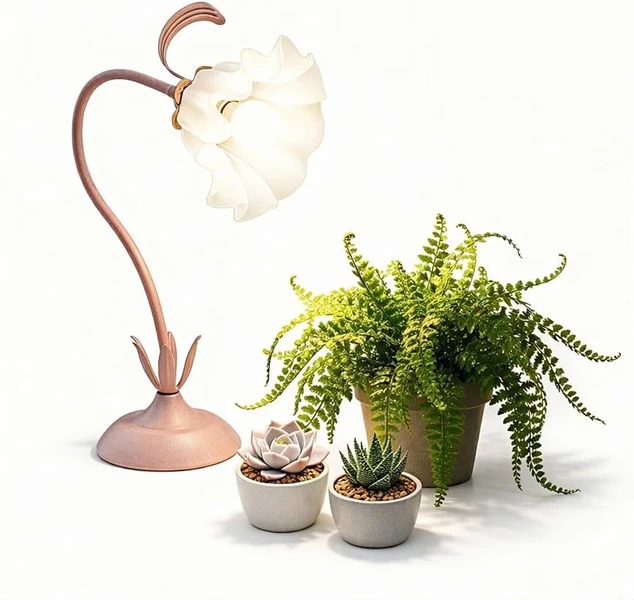
Amazon.com: Table Top Grow Light for Indoor Plants – Decorative Desk Plant Light for Succulents Bonsai Cactus, Adjustable Desktop Grow Lights with B (Source: amazon.com) -
Govee Smart Grow Light — Best smart option
The Govee Smart Grow Light (~$50–70) is Matter-compatible as of 2026, meaning it works with Apple Home, Google Home, and Amazon Alexa without a proprietary hub. You can set 12, 14, or 16-hour light cycles through the Govee app or your existing smart home platform. PPFD at 12 inches is modest — around 120 μmol/m²/s — which makes it the right call for peace lilies, pothos, or low-light philodendrons, not for herbs that need intensity. The smart scheduling feature is genuinely useful: consistency in photoperiod matters more than most people realize. The flaw is straightforward — at this PPFD, you're paying a $50 premium for convenience, not plant performance.
-
GE Grow Light Bulb BR30 — Best budget aesthetic pick
The GE BR30 (~$10–15) fits any standard Edison or candelabra socket, looks like a normal household bulb, and outputs 5000K daylight spectrum. At 18 inches, PPFD lands around 65 μmol/m²/s. That number tells you everything: this is a decorative-plant light. Snake plants, ZZ plants, and peace lilies will do fine under it. Basil will die slowly. Buy it knowing exactly what it is — a low-cost, aesthetically neutral supplement for low-demand plants — and it's a solid $12 spend.
Matching Grow Lights to Your Room
Living room and open-plan spaces
Pendant-style lights work well over statement floor plants in living rooms, but color temperature is critical. Keep it at 3000K–4000K. Anything above 4000K reads as clinical — the kind of flat, harsh white that flattens a room's ambiance. The Soltech Aspect outputs a warm white that passes as ambient pendant lighting. Most guests won't know it's a grow light. That's the goal.
For open shelving in a living room, the Barrina T5 strips mounted under each shelf tier create a layered lighting effect that's actually attractive while delivering real photon output to each shelf level.
Kitchen shelves and herb gardens
The kitchen is where grow lights pay off most practically. Strip lights under upper cabinets do double duty: task lighting for your countertop and grow lighting for herbs. Barrina T5 at 5000K is the right call here — the cooler tone suits kitchens and matches natural daylight from nearby windows. Herbs need 20–30 mol/m²/day DLI, which means you need both adequate PPFD and adequate duration. Aim for 14–16 hours of strip lighting at counter height.
Bedroom plant corners
Lower PPFD is acceptable in bedrooms — peace lilies, pothos, and snake plants are forgiving. But light spectrum matters more here than anywhere else. According to the Sleep Foundation, blue-spectrum light above 4000K suppresses melatonin production and disrupts sleep onset. A 6500K grow light running until 10 PM in your bedroom will affect your sleep quality. The solution: keep color temperature at 2700K–3000K, use a timer to cut off lights by 8 PM, and use the Govee's scheduling feature. The warm spectrum is also less effective for high-demand plants, which reinforces why bedrooms should host low-light species only.
Color Temperature, Spectrum, and What Actually Grows Plants
2700K vs 4000K vs 6500K: what each does
Color temperature is measured in Kelvin, and it describes the warmth or coolness of white light. For grow lights, it's both a horticultural tool and an aesthetic choice:
- 2700K (warm white): Mimics sunset spectrum. Good for orchids, succulents in bloom, and flowering stages generally. Least disruptive aesthetically — blends into ambient home lighting naturally.
- 4000K (neutral white): The all-rounder. Ideal for tropical foliage — monsteras, philodendrons, pothos — during vegetative growth. Looks clean and modern without being harsh. This is the sweet spot for most indoor plant setups.
- 6500K (cool daylight): Aggressive vegetative growth. Correct for herb starts, seedlings, and any plant that demands high-light conditions. Looks harsh in living spaces and reads blue-white to the eye. Reserve this for kitchens or utility shelving where ambiance isn't the priority.
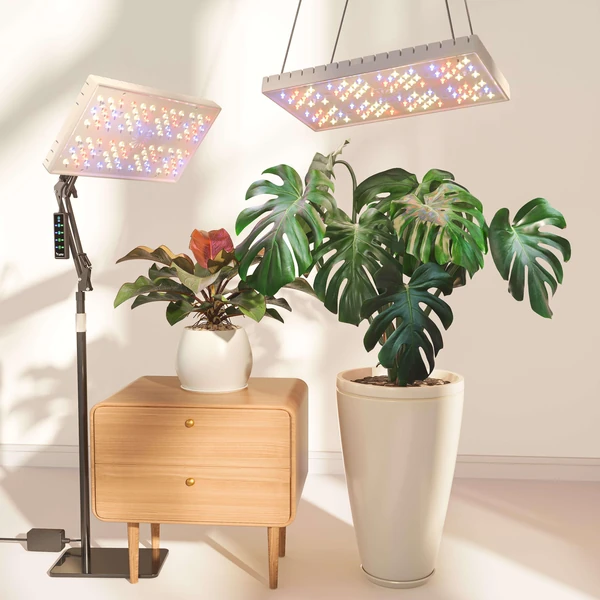
Why full-spectrum beats 'blurple' for home use
The old red-blue LED panels — the ones that turn your living room into a crime scene — are obsolete for home use. Full stop. Research published in Scientia Horticulturae confirms that broad-spectrum white LEDs produce equivalent or superior plant growth compared to narrow-band red-blue arrays, with the added benefit of making plant health visible to the grower. You can't see yellowing, spotting, or nutrient deficiency under blurple — everything looks pink-purple.
Full-spectrum white lights let you see your plants in true color. That matters. Blurple panels made sense in 2015 when efficient white LEDs were expensive. They don't make sense now. The Spider Farmer SE series and Fluence SPYDR — both commercial benchmarks — run full-spectrum white precisely because the science supports it. Home growers should follow the same logic.
The Wattage-Per-Square-Foot Math Nobody Tells You
How to calculate what you actually need
A common rule of thumb: aim for 20–40 true watts per square foot for moderate-light plants, and 40–60 watts per square foot for high-demand plants like herbs, citrus, or anything that would naturally sit in full outdoor sun.
Run the numbers on a typical decorative setup. A 10W Edison-style grow bulb covering a 4-square-foot shelf delivers 2.5 watts per square foot. That's maintenance mode for pothos. It is a slow death sentence for basil. The math is unambiguous.
When decorative lights aren't enough
Here's a practical decision tree:
- If your plant tolerates low-light conditions outdoors (snake plant, ZZ plant, pothos, peace lily): a decorative grow light in the 50–100 PPFD range works fine.
- If your plant needs 4–6 hours of bright indirect outdoor light (monstera, philodendron, fiddle leaf fig): you need 150–250 PPFD minimum. Most pure-aesthetic fixtures won't reach it.
- If your plant needs direct outdoor sun or 6+ hours of bright light (herbs, citrus, fruiting plants): you need 400+ PPFD. No pendant-style decorative fixture on the current market delivers this. You need a real horticultural light.
DLI — Daily Light Integral — is the cumulative photon dose your plant receives over a full day. According to Oklahoma State University Extension, most tropical foliage plants target 10–20 mol/m²/day, while herbs want 20–30 mol/m²/day. A 120 PPFD light running 16 hours delivers roughly 6.9 mol/m²/day — enough for low-light tropicals, not enough for herbs. That's why duration alone doesn't save an underpowered fixture.
Smart Grow Lights and Home Automation in 2026
Matter, Zigbee, and why it matters for plant schedules
The Matter smart home standard — finalized in 2022 and mainstream by 2025–2026 — means smart grow lights from different brands can now operate in the same ecosystem without proprietary hubs or workarounds. Govee's current grow light lineup supports Matter. Several third-party full-spectrum bulbs, including some Sansi variants, also work with Matter-compatible switches and plugs.
This matters practically: you can run a 14-hour light cycle that actually sticks, integrated with your Apple Home or Google Home automations, without babysitting a separate app. Consistency beats intensity for most plants. A reliable 14-hour cycle at 120 PPFD outperforms an irregular 8-hour blast at 200 PPFD for tropical foliage — the plant's photosynthetic machinery adapts to predictable light cycles.
Best apps and integrations for automated light cycles
Be honest about the trade-off: smart features add $30–60 to the price of any grow light, and none of those features improve PPFD output. You're buying convenience and automation, not better plant growth. If that automation fits your lifestyle — you travel, you forget, your schedule is irregular — it's worth the premium. If you'd rather set a mechanical outlet timer for $8 and forget it, that works just as well for the plant.
If you're already running Apple Home or Google Home, the cleanest setup is a Matter-compatible smart outlet plug paired with the Sansi 36W in a lamp you already own. Total cost: about $35. Zero new hardware on your shelf. The lamp stays the lamp; the schedule runs in the background.
What We'd Actually Buy
Clear winner: the Soltech Solutions Aspect. If you want genuine plant performance and a fixture that looks intentional in your home, this is the one to buy. Yes, it's $180. The output justifies the price for any plant that needs real light — monsteras, fiddle leaf figs, herbs on a dining table setup. It's the only pendant-style grow light that doesn't require you to apologize for the trade-off between form and function.
Runner-up, and honestly the smarter move for most people: the Sansi 36W full-spectrum bulb in a lamp you already own. It costs $25. It works in any standard socket. It delivers real spectrum and real PPFD. And it lets you keep whatever lamp aesthetic you've built — no new fixture, no new design decision to make.
If I had $200 and one plant shelf to light, I'd buy the Sansi 36W for $28 and spend the remaining $172 on a good-looking floor lamp from West Elm or CB2. You get better total design control, real horticultural output, and money left over. That's the move.
What to skip: any grow light marketed primarily through Instagram content with vague "full spectrum" language and no PPFD data published on the product page. If the brand won't tell you how many photons their light delivers, that silence is the answer. Also avoid growing demanding plants — herbs, citrus, anything fruit-producing — under any fixture on this list without running the wattage-per-square-foot math first. A beautiful light that's killing your basil isn't worth keeping.
One more thing: if fungus gnats or soil pests show up after improving your plant setup (more light means more watering, which means wetter soil), the guide on best gnat killer for indoor plants covers the fastest fixes. And if you're rebuilding a shelf setup from scratch, pairing good lighting with best soil for indoor plants with no bugs cuts off most pest problems before they start.
Frequently Asked Questions
Do stylish grow lights actually work for plants?
Some do, most don't — it depends entirely on their PPFD output, not their appearance. Pendant-style grow lights typically deliver 50–150 PPFD at 12 inches, which works for low-light species like pothos and snake plants but fails herbs and fruiting plants. Check for published PPFD data before buying. If a brand doesn't list it, that's a red flag.
Can grow lights replace sunlight entirely for indoor plants?
Yes, for most houseplants — but only if the light delivers adequate PPFD for the required daily duration. A 14–16 hour cycle at 150–250 PPFD replaces moderate indirect sunlight for tropical foliage plants. High-demand plants like herbs and citrus need 400+ PPFD for 14+ hours, which requires dedicated horticultural fixtures, not decorative pendants.
How far should a grow light be from my plants?
For most decorative LED grow lights, 12–18 inches from the plant canopy is the target range. At 18 inches, most stylish fixtures output 50–200 PPFD depending on wattage. Closer placement increases intensity but risks heat stress on delicate foliage — check your fixture's heat output before moving it in tight. Shelf strip lights like the Barrina T5 work best at 6–10 inches.
Do grow lights disturb sleep?
Blue-spectrum lights above 4000K do suppress melatonin and disrupt sleep onset, particularly in the two hours before bed. For bedroom plant setups, keep color temperature at 2700K–3000K and use a timer to cut lights off by 8 PM. The Govee Smart Grow Light's scheduling feature handles this automatically once configured.
Are pink or purple grow lights better than white full-spectrum LEDs?
No. Full-spectrum white LEDs are superior for home use in every practical way. They grow plants equally well or better than red-blue 'blurple' panels, they render plant color accurately so you can diagnose problems, and they don't turn your living room into a cannabis operation aesthetic. Blurple panels are obsolete for anything outside a sealed grow tent.
How much electricity do grow lights use?
Very little at normal home-use wattages. A 40W LED running 14 hours per day costs roughly $2–3 per month at average US electricity rates. Even running two or three fixtures continuously adds under $10/month to most electric bills. Energy use is not a meaningful factor in choosing between stylish grow lights.