Tiny Black Bugs on Plants: ID & Fix Guide
Tiny black bugs on plants? ID fungus gnats, black aphids, thrips & soil mites fast — plus exact treatment ratios that actually work.
Key Takeaways
- Identify the bug by location first: soil-dwelling pests like fungus gnats need different treatment than leaf pests like black aphids or thrips.
- Overwatering is the root cause behind most fungus gnat and soil mite infestations — letting the top 2 inches of soil dry out between waterings often breaks the cycle without any products.
- Mosquito Bits (Bti) are the most effective fungus gnat treatment available and completely safe for plants, pets, and beneficial insects — yet most care guides skip them entirely.
- White or tan mites in your soil are harmless decomposers; only dark, fast-moving mites on stems or foliage need treatment.
- For foliar pests, mix 2 tsp neem oil + 1 tsp Dawn dish soap per 1 quart water and apply every 5–7 days for 3 weeks — one application won't break the egg cycle.
- Quarantine all new plants for at least 2 weeks before placing them near your existing collection — this single habit prevents most infestations from starting.
How to Identify Tiny Black Bugs on Your Houseplants
Most tiny black bugs on plants fall into four categories: fungus gnats, black aphids, thrips, or soil mites. The fastest way to narrow it down is location. Bugs living in or near the soil need completely different treatment than bugs feeding on leaves and stems. Mixing up the diagnosis wastes time and money — and lets the infestation grow.
Grab a magnifying glass or use your phone's macro lens. At under 2 mm, a quick close-up photo can settle the ID question in seconds.
Bugs in the Soil vs. Bugs on Leaves and Stems
Soil-dwellers: fungus gnats and soil mites. Foliage pests: black aphids and thrips. That single split cuts your treatment options in half immediately.
Fungus Gnats
Fungus gnats measure 1–2 mm. The adults are dark, winged, and fly upward in a small cloud when you water or move the pot. The real damage, though, comes from their larvae — translucent, thread-like worms that live in the top inch of moist soil and feed on plant roots. According to UC Cooperative Extension, fungus gnat larvae are strongly linked to overwatered growing media, where moist organic matter gives females a viable place to lay eggs.
Black Aphids
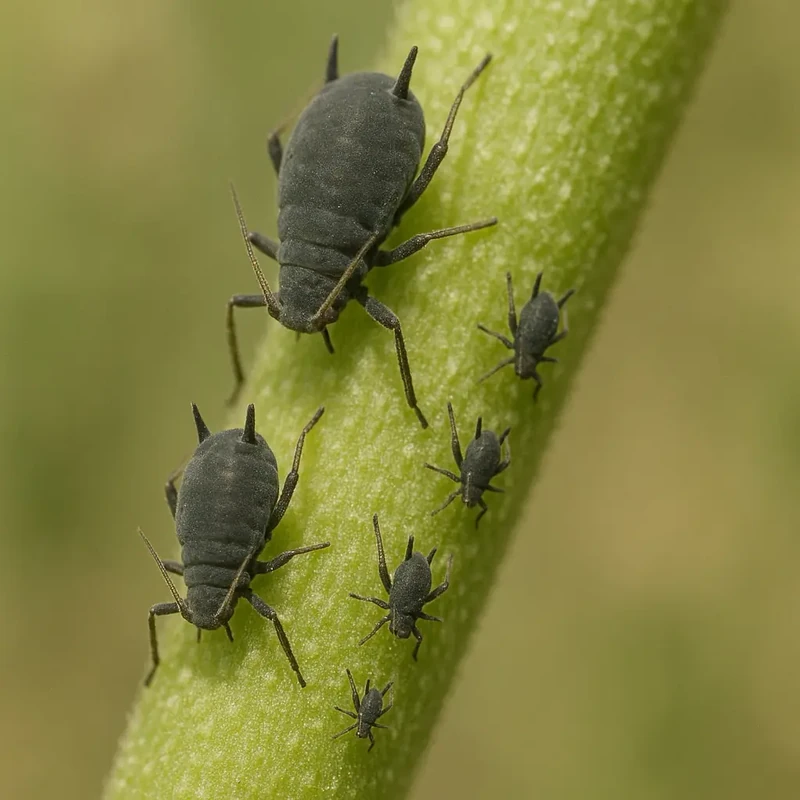
Aphis fabae, or black bean aphids, run 1–3 mm. They have soft, pear-shaped bodies and cluster on new growth, tender stems, and the undersides of leaves. The sticky, shiny residue they leave behind is honeydew — a waste product that invites sooty mold if you ignore it long enough. Colonies can double in size within 48 hours in warm indoor conditions.
Thrips
Thrips are 1–2 mm, slender, and fast-moving. They rasp plant tissue rather than piercing it, leaving silver or bronze streaking across leaf surfaces. That streaking is the signature tell. It's the pest most commonly misidentified as a nutrient deficiency or spider mite damage — neither of which it is.
Soil Mites
Here's the distinction almost no one makes clearly: white or tan soil mites are almost always harmless. They're saprophytic decomposers breaking down organic matter in the potting mix, and they do not attack living plant tissue. You do not need to treat them. The mites worth acting on are dark-colored, fast-moving, and cluster on lower stems or foliage. If your mites are white and stay in the soil, leave them alone.
Quick-Reference: Match the Bug to the Fix
As of April 2026, these four pests account for the vast majority of "tiny black bug" reports on houseplant forums. Use this table to match what you're seeing to the right response.
| Bug | Size | Where Found | Damage Type | Top Treatment |
|---|---|---|---|---|
| Fungus Gnats | 1–2 mm | Soil surface, flying near pot | Root damage (larvae); cosmetic annoyance (adults) | Mosquito Bits + let soil dry |
| Black Aphids | 1–3 mm | Stems, new growth, leaf undersides | Sticky honeydew, curled/yellowed leaves | Insecticidal soap or neem oil spray |
| Thrips | 1–2 mm | Leaf surfaces, inside flower buds | Silver streak scarring, deformed growth | Neem oil spray + yellow sticky traps |
| Soil Mites (harmful) | <1 mm | Soil and lower stems | Minor root and stem damage | Hydrogen peroxide soil drench |
Note: White or tan soil mites are beneficial decomposers. No treatment needed.
Signs Your Plant Is Under Attack
Bugs this small rarely announce themselves. You usually notice the damage before the pest. Watch for these signals:
- Yellowing or wilting leaves with no obvious watering explanation — often the first sign of root-feeding larvae, especially fungus gnat larvae in the top inch of soil.
- Sticky residue on leaves or the surface below the pot — this is honeydew, and it almost always means aphids. Left untreated, it feeds sooty mold growth.
- Silver or bronze streaking on leaf surfaces — thrips signature. People routinely mistake this for a magnesium deficiency or spider mite damage. It's neither.
- Small flies rising from the soil every time you water or move the plant — classic fungus gnat indicator. One or two flying around the kitchen could be fruit flies. A cloud that emerges from the pot is not.
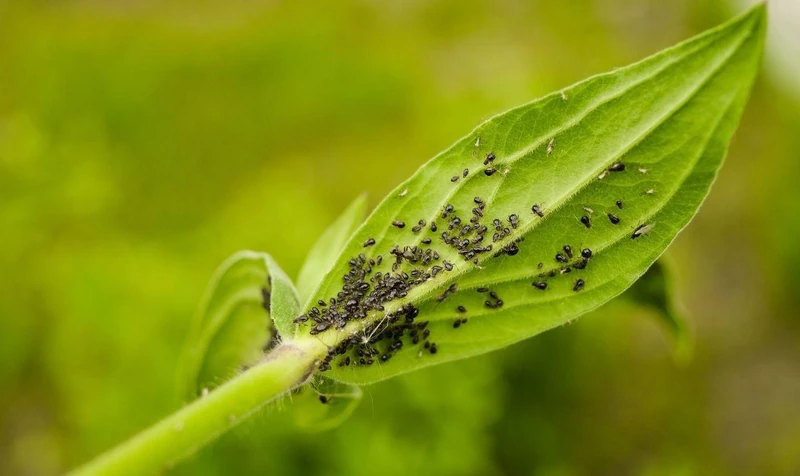
- Dark clusters on stems or new growth — black aphid colonies. They build fast. What looks like a few dots on Monday can be a dense colony by Wednesday.
- Sudden wilting in a plant that was otherwise healthy — when this happens without root rot and without drought stress, suspect significant larval root damage. At that point, treatment urgency goes up.
The Overwatering Connection
Overwatering isn't just a secondary risk factor. It's the single upstream cause that enables fungus gnats, harmful soil mites, and root rot to develop simultaneously. Most pest guides mention it in a sidebar. It deserves the headline.
Fungus gnats can only lay viable eggs in moist organic matter. No moisture, no viable egg-laying cycle. According to UC IPM's pest notes on fungus gnats, moist potting soil with high organic content is the primary driver of infestation, and reducing soil moisture is a core management strategy — not just a nice-to-have.
Saturated soil also fuels population booms in soil mites, even the harmless decomposer varieties. The decomposing organic material in a chronically wet pot is a feeding buffet.
The practical fix: let the top 2 inches of soil dry completely before watering again. Don't test this by touching the surface — push a finger an inch or two into the mix. If it's still damp, wait.
For mild infestations, this single adjustment — with nothing else — breaks the pest cycle in 2–3 weeks. That's the zero-product solution. No spray, no drench, no granules. Just corrected watering frequency.
How to Get Rid of Tiny Black Bugs on Plants
When watering correction alone isn't enough, these five treatments cover the full range of tiny black bug problems. Pick based on what you identified above — don't apply all five at once.
Neem Oil Spray (Best All-Rounder for Foliar Pests)
Neem oil is the most versatile foliar treatment for aphids and thrips. The exact ratio that works: 2 tsp neem oil + 1 tsp Dawn dish soap per 1 quart of water. Shake before each spray. Apply to all leaf surfaces, especially undersides where pests congregate. Repeat every 5–7 days for 3 full weeks — one application will not break the egg cycle.
Do not spray in direct sun. The oil can magnify light and cause leaf burn. Evening application is ideal. Avoid using neem on waxy-leaved succulents, African violets, or fuzzy-leafed ferns — it can clog pores or damage surface coatings. Test on one leaf 24 hours before full application if you're unsure.
Insecticidal Soap or Diluted Dish Soap
Insecticidal soap kills soft-bodied insects — aphids and thrips specifically — on contact by disrupting their cell membranes. Safer Brand's insecticidal soap is the most consistent commercial option; the concentration is standardized, unlike DIY batches. If you're mixing your own, use 1 tbsp Dawn dish soap per 1 quart of water. Coverage is everything here — this treatment only kills what it physically touches, so get under the leaves.
Hydrogen Peroxide Soil Drench for Larvae
This targets fungus gnat larvae and harmful soil mites living in the root zone. Mix 1 part 3% hydrogen peroxide to 4 parts water. Pour through the soil until it drains from the bottom. The fizzing reaction you'll see kills larvae without harming plant roots — the peroxide breaks down into water and oxygen quickly. Repeat once after 7 days if adults are still appearing.
Mosquito Bits and Bti for Fungus Gnats
This is the fix r/houseplants recommends above everything else, and it's completely absent from most top-ranking articles on the subject. Mosquito Bits contain Bacillus thuringiensis var. israelensis (Bti), a naturally occurring soil bacterium. According to EPA biopesticide data, Bti specifically destroys the gut lining of fungus gnat larvae while being entirely safe for plants, people, pets, and beneficial insects.
Application: sprinkle granules on the soil surface and water them in normally. Repeat every 2–3 waterings. The Bti works in the soil where larvae live — it doesn't touch the flying adults, which is why pairing it with yellow sticky traps catches both life stages.
Diatomaceous Earth for Crawling Pests
Food-grade diatomaceous earth only — never pool-grade. Dust a thin layer on the soil surface. The microscopic silica particles physically shred crawling insects' exoskeletons. It loses effectiveness when wet, so reapply after each watering. It's not useful for flying pests. Think of it as a surface barrier, not a standalone solution.
Yellow sticky traps are worth keeping near any affected plant during treatment. They catch adult fungus gnats and winged aphids. More importantly, the trap count tells you whether your treatment is working — a declining catch over two weeks means you're winning.
How to Prevent Tiny Black Bugs From Coming Back
Most infestations enter through new plants. Quarantine every new purchase for at least 2 weeks before placing it near your existing collection. That's not optional — it's the single most effective prevention step available.
At the nursery or garden center, check the soil, not just the leaves. Musty-smelling soil or waterlogged mix is a red flag regardless of how clean the foliage looks. Healthy leaves don't rule out larvae in the root zone.
A few structural changes that dramatically reduce reinfestation risk:
- Top-dress pots with coarse sand or diatomaceous earth. A thin surface layer deters fungus gnat egg-laying by keeping the top inch inhospitable.
- Use a well-draining potting mix with added perlite. Dense, moisture-retaining mixes — especially heavily peat-based ones — are pest incubators. More drainage means faster drying between waterings.
- Switch to bottom-watering for gnat-prone plants. Fill a tray, let the pot absorb water from below, then empty the tray. The top inch of soil stays dry. Fungus gnats can't complete their egg-laying cycle without surface moisture.
- Remove dead leaves and decaying organic matter promptly. Fungus gnats breed in decomposing plant material sitting on the soil surface — not just in wet soil alone.
- Keep yellow sticky traps near vulnerable plants as an early warning system. Catching 3 gnats in week one beats catching 300 in week six.
Frequently Asked Questions
Are the tiny white bugs in my soil harmful?
Almost certainly not. White or tan mites in potting soil are typically beneficial decomposers breaking down organic matter. They do not attack healthy plant tissue. You only need to act if you see dark, fast-moving mites clustering on stems or foliage, or if the plant is showing damage symptoms like wilting or stunted growth.
How do I know if I have fungus gnats or fruit flies?
Location is the tell. Fungus gnats emerge from plant soil and stay near it — they scatter when you disturb a pot. Fruit flies are attracted to ripening fruit and food waste in the kitchen. If the flies come out of the soil when you water, it's almost certainly fungus gnats, not fruit flies.
Can I use neem oil and Mosquito Bits at the same time?
Yes, and doing so is actually the fastest resolution strategy during an active fungus gnat infestation. Mosquito Bits (Bti) handle larvae in the soil; neem oil foliar spray handles adult gnats and any other pests on the leaves. They target different life stages and don't interfere with each other.
How long does it take to get rid of fungus gnats completely?
Expect 3–4 weeks minimum. Adults live 7–10 days. Even if you eliminate every larva today, eggs already in the soil take 4–6 days to hatch. You need consistent treatment across at least 3 full watering cycles. Stopping early after the adults disappear is the most common reason infestations return.
What is the safest treatment for tiny black bugs on plants near kids or pets?
Mosquito Bits (Bti) and diatomaceous earth (food-grade) are the safest options. Bti is a naturally occurring bacterium with no toxicity to mammals. Food-grade diatomaceous earth is also non-toxic but avoid inhaling the dust during application. Neem oil is low-toxicity but has a strong odor — apply in a well-ventilated space.