Best Grow Lights for Monstera (2026 Guide)
Find the best grow lights for monstera in 2026. We cover PPFD tiers, real running costs, and top picks like Soltech Aspect Gen 2.
Key Takeaways
- Monstera deliciosa needs 400–800 foot-candles (4,300–8,600 lux) to grow well — most US interiors deliver far less, especially from November through February.
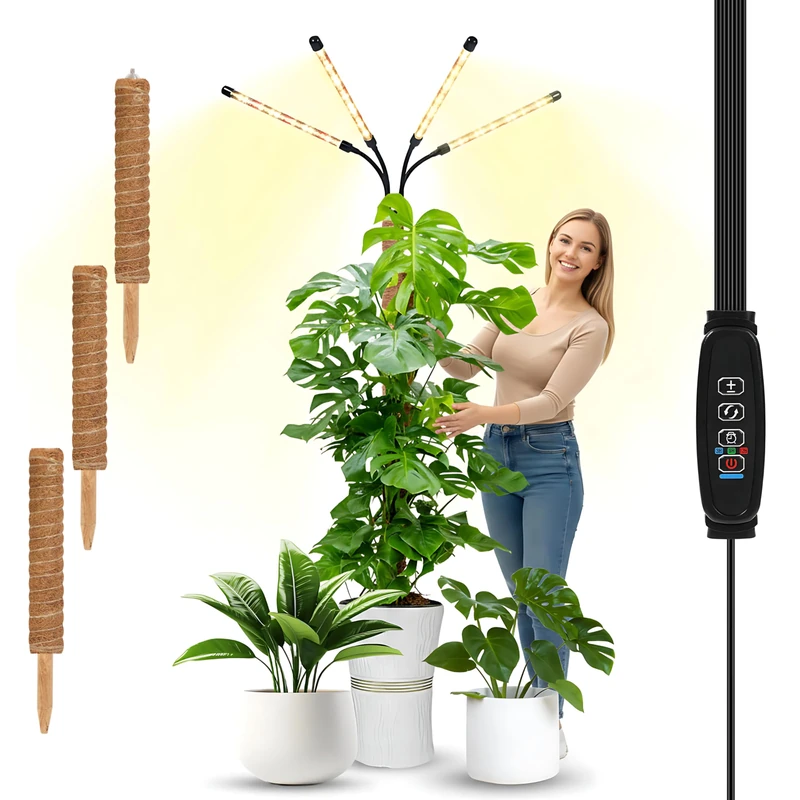
- Full-spectrum LED is the only grow light type worth buying in 2026; the Spider Farmer SF1000 is the best panel pick, and the Soltech Aspect Gen 2 is the best option for living rooms.
- PPFD tiers matter: 50–100 µmol/m²/s for survival, 100–150 µmol/m²/s for steady growth, and 150–200 µmol/m²/s to encourage fenestration development on mature plants.
- Running a 20–45W LED grow light at 14 hours per day costs just $13–$30 per year at average US electricity rates — electricity cost is not a meaningful concern.
- Adding a grow light accelerates soil dry-out by roughly 20%; switch to moisture-based watering checks instead of a fixed calendar schedule to avoid accidental underwatering.
- Clip-on grow lights are nearly useless for mature monstera with a 3–5 foot spread — use a ceiling pendant or floor arc lamp for adequate canopy coverage.
Does Your Monstera Actually Need a Grow Light?
The short answer: if your Monstera deliciosa sits more than 6 feet from a south or west-facing window — or if you live above the 40th parallel and it's anywhere between November and February — yes, it probably does. Most US apartments deliver somewhere between 50 and 150 foot-candles (a unit of illuminance where one foot-candle equals roughly 10.76 lux) in interior rooms. Monstera needs a minimum of 400 foot-candles to grow. That's not a small gap.
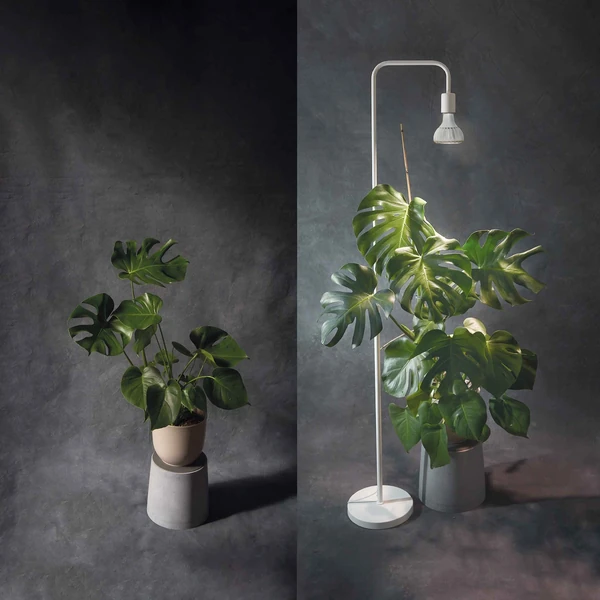
Grow lights — specifically full-spectrum grow lights, which emit light across the full wavelength range plants can use — aren't just for grow tents and commercial operations. They're a practical, affordable tool for closing the seasonal light deficit that kills momentum on plants that were thriving in September. A grow light won't replicate a south-facing window in July. But through winter, it absolutely bridges the difference between a plant that's stalling and one that's still pushing new leaves.
If you're not sure whether your monstera is struggling, the signs are easy to read. Leggy stems, small new leaves, zero fenestrations on a mature plant — all of those point to one root cause. Let's establish what the numbers actually mean before we get to specific products.
Monstera Light Requirements and the PPFD Tier System
Monstera deliciosa is a forest-canopy understory plant in the wild. It evolved under dappled, diffused light — not direct equatorial sun, but also not the dim corner of a studio apartment. According to the University of Maryland Extension, most tropical foliage houseplants need a minimum of 200–500 foot-candles for maintenance, with 500–1,000 foot-candles for active growth. For monstera specifically, the practical target is 400–800 foot-candles (roughly 4,300–8,600 lux, where lux is the metric equivalent of foot-candles measured in lumens per square meter).
In technical terms, that translates to PPFD — Photosynthetic Photon Flux Density — measured in micromoles per square meter per second (µmol/m²/s). PPFD is the count of photons in the PAR (Photosynthetically Active Radiation) band that actually strike a surface each second. PAR covers the 400–700nm wavelength range that plants absorb and use for photosynthesis — everything outside that range is mostly heat or wasted energy. When you see a grow light advertised with a PPFD number, that's the figure that tells you how much usable plant energy it delivers at a given distance.
Here's the tier breakdown that most grow light guides completely skip:
| PPFD Range (µmol/m²/s) | What It Does | Practical Outcome |
|---|---|---|
| 50–100 | Survival / maintenance mode | Plant holds existing leaves, minimal new growth |
| 100–150 | Active vegetative growth | Steady leaf production, healthy color |
| 150–200 | High-output growth | Best conditions to drive fenestration development |
Most competitors give you one vague number or none at all. The tier matters because your goal changes what hardware you need. Keeping a small juvenile alive through winter requires a very different setup than pushing a mature plant to develop splits.
On color temperature: look for LEDs rated 4000K–6500K. That range mimics natural daylight and emphasizes the blue wavelengths (400–500nm) that drive vegetative growth. Warmer bulbs (2700K–3000K) skew red, which supports flowering — not useful for a foliage plant.
7 Signs Your Monstera Isn't Getting Enough Light
Before spending money on hardware, confirm the diagnosis. If you want a precise reading, a light meter takes the guesswork out entirely — an inexpensive lux meter converts to foot-candles at a 10.76:1 ratio.
- Leggy growth — unusually long gaps between leaf nodes as the stem stretches toward any available light source
- Small new leaves — each emerging leaf is noticeably smaller than the mature leaves already on the plant
- No fenestrations — this is the clearest signal; a monstera past the juvenile stage producing solid, uncut leaves is almost always light-limited
- Yellowing lower leaves — not linked to overwatering or root rot, just fading from the bottom up
- No new growth for 8+ weeks outside of genuine winter dormancy (which is rare in heated US homes)
- Hard lean to one side — the plant is physically orienting its stem toward the only viable light in the room
- Soil staying wet for 3+ weeks — low light slows metabolism and reduces water uptake; your watering schedule hasn't changed but the conditions have
Three or more of these together? A grow light is the right call. If you're also noticing yellowing on new growth rather than old leaves, that's a separate issue worth ruling out before you invest in more light.
Best Types of Grow Lights for Monstera (With a Clear Winner)
There are three main categories. One is the right answer. Here's the comparison:
| Light Type | Efficiency (lm/W) | Heat Output | Lifespan | Full PAR Spectrum | Typical Cost |
|---|---|---|---|---|---|
| Full-Spectrum LED | 80–160 lm/W | Low | 50,000+ hours | Yes | $30–$200 |
| Fluorescent / CFL | 35–100 lm/W | Moderate | 8,000–15,000 hours | Partial | $15–$80 |
| Incandescent | 10–17 lm/W | Very High | 1,000 hours | No | $5–$15 |
| HID (High-Intensity Discharge) | 75–150 lm/W | Very High | 10,000–24,000 hours | Partial | $100–$500+ |
Full-spectrum LED (Light Emitting Diode) wins. Not as one option among several — as the only rational choice for a home monstera setup in 2026. LED technology works by passing current through a semiconductor that emits light at specific wavelengths; full-spectrum LEDs are engineered to cover the entire PAR band rather than just red and blue peaks. The price gap between LED and fluorescent has closed almost completely, and LED outperforms on every metric that matters: efficiency, heat, lifespan, and spectrum quality.
Full-Spectrum LED: Top Picks
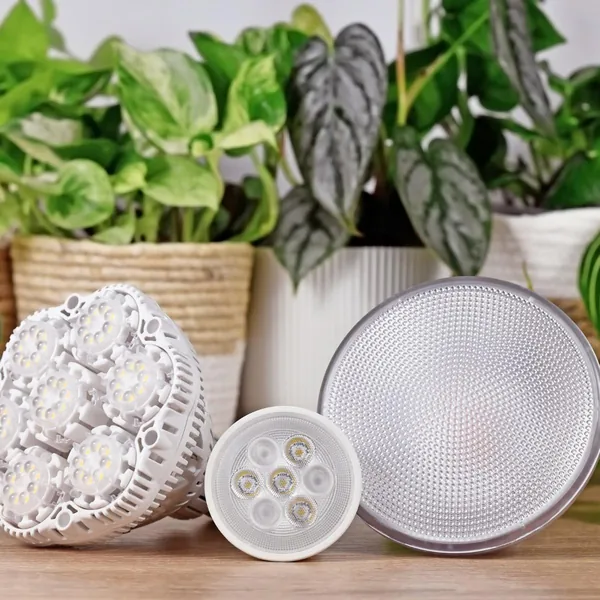
Before getting into specific products, one distinction that almost no houseplant guide covers: blurple LEDs vs. white full-spectrum LEDs. Blurple fixtures emit that distinctive purple-pink glow because they combine high-intensity red and blue diodes. They deliver PAR efficiently. They also make your living room look like a cannabis operation. For a monstera in a living space, white full-spectrum LEDs rated 4000K–5000K deliver comparable plant results without the aesthetic penalty. This is not a minor consideration — it affects whether the light actually stays in use.
Two products worth naming specifically:
- Spider Farmer SF1000 (released 2019, ~$100 street price as of April 2026, ~100W true draw) — Best for: a dedicated plant corner, shelf setup, or spare room where aesthetics don't matter. This is a panel-style fixture with strong PPFD output across a wide coverage area. It's not subtle. But for pure plant performance, it's hard to beat at the price point. Hang it 24–36 inches above a mature monstera for the 100–150 µmol/m²/s range.
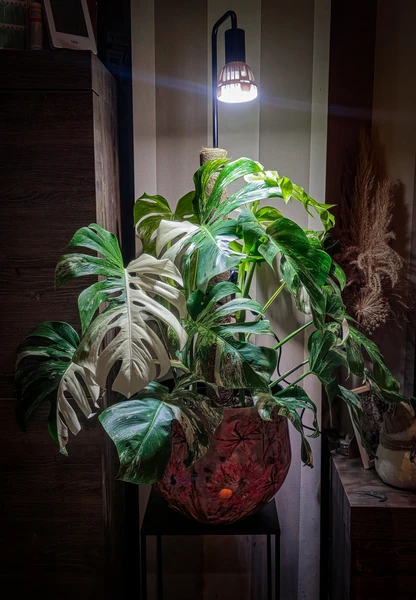
- Soltech Aspect Gen 2 (updated 2023, ~$165–$185 retail, pendant-style white LED) — Best for: a monstera in a living room or bedroom where the light needs to look like décor, not hardware. The Aspect Gen 2 is designed to hang from a ceiling hook and looks like a standard pendant lamp. White output, no purple cast, and calibrated for 24–30 inches above the plant. It's the right pick if your monstera is a design element, not just a plant.
Budget-conscious? Decent full-spectrum LED panels start around $30–$50 on Amazon — brands like Barrina and Roleadro have consistent track records. They won't win any design awards, but they work. For a deeper comparison of panel vs. pendant styles, see our full grow light roundup.
Fluorescent and CFL: Still Viable, But Fading
Fluorescent T5 and T8 fixtures are still a legitimate option for seedlings, propagation setups, or shelf gardens where you want long, even coverage at low cost. The T5 HO (High Output) format delivers decent PPFD at 4–6 inches — close enough for smaller plants. CFLs (Compact Fluorescent Lamps) work for a single plant on a budget, though their PPFD drops sharply beyond 12 inches.
The main tradeoff: fluorescents cover partial PAR spectrum, run warmer than LEDs, and require ballast replacement as they age. For a new purchase in 2026, there's almost no scenario where fluorescent beats a comparably priced LED. But if you already own fluorescent fixtures, they'll do the job — especially combined with the natural light your monstera already receives. Pair them with a programmable timer to maintain consistent photoperiods through winter.
HID and Incandescent: Skip Both
HID lighting (Metal Halide, High Pressure Sodium) is engineered for commercial grow operations. The heat output alone rules it out for home use without dedicated ventilation. Incandescent bulbs produce almost no usable PAR — nearly all their energy converts to heat, not light. Neither belongs in a monstera care setup.
How to Position a Grow Light for Monstera
Distance matters more than most product descriptions acknowledge. PPFD follows the inverse square law: double the distance, quarter the light intensity. A light delivering 200 µmol/m²/s at 12 inches delivers roughly 50 µmol/m²/s at 24 inches. Here are the practical guidelines:
- High-output panels (60W+): Position 24–36 inches above the plant canopy. Closer risks light bleaching on large leaves.
- Mid-range LED fixtures (20–40W): 12–24 inches, depending on the fixture's PPFD data.
- CFL or small LED bulbs: 6–12 inches for useful light levels — these fixtures drop off fast with distance.
For monstera specifically, aim to illuminate the top two-thirds of the plant. Hanging the light directly overhead rather than to one side prevents the stem lean that signals directional light stress. If you're supplementing existing window light rather than replacing it, position the grow light on the opposite side of the plant from the window to distribute coverage more evenly. This setup pairs well with a consistent monstera care routine that adjusts watering frequency based on light levels.
How Many Hours Per Day Does a Monstera Need Under a Grow Light?
The standard recommendation is 12–16 hours per day for a monstera under supplemental grow lighting. Darkness matters too — plants use the dark period for respiration and growth hormone regulation. Running lights 24 hours does not accelerate growth and may stress the plant over time.
A programmable outlet timer eliminates the need to manually switch lights. Set it for a consistent window — 7am to 9pm, for example — and don't adjust it seasonally unless you're actively pushing the plant into a growth phase. Consistency is more important than the precise hour count within the 12–16 hour range.
If you're combining grow light hours with natural window light, count both toward the total. A plant near a north-facing window getting 4–5 hours of ambient daylight only needs 8–10 additional hours from the grow light to hit the target range. A seasonal light adjustment guide can help you dial in the balance as conditions shift through the year.
Common Grow Light Mistakes to Avoid
A few patterns show up repeatedly in forums and in failed setups:
- Buying by wattage instead of PPFD — Wattage tells you energy consumption, not light output. A 45W full-spectrum LED can outperform a 100W blurple fixture depending on driver efficiency and diode quality. Always look for PPFD data at the hanging distance you plan to use.
- Positioning the light too far away — The most common mistake. Most people hang lights at ceiling height and wonder why nothing changes. Measure and adjust based on the fixture's PPFD chart.
- Using a warm-spectrum bulb — A 2700K LED marketed as "grow light" is optimized for flowering, not vegetative growth. For monstera, stay in the 4000K–6500K range.
- Skipping a timer — Manual switching leads to inconsistent hours. Inconsistent photoperiods slow growth almost as effectively as insufficient light.
- Expecting immediate results — A monstera that's been light-stressed for months won't bounce back in a week. Give it a full growth cycle (6–8 weeks) before evaluating whether the setup is working. Track progress by measuring new leaf size over time rather than watching for dramatic overnight changes.
The Bottom Line
If your monstera is stalling, the light situation is almost certainly the cause — and a full-spectrum LED grow light is the most direct, cost-effective fix available. Match the fixture output to your goal using the PPFD tiers above, position it correctly, run it on a timer for 12–16 hours, and give the plant time to respond. That's the entire framework. Everything else is secondary.
Frequently Asked Questions
Can monstera survive without a grow light?
Yes — if it has reliable access to a bright window (south or west-facing, within 3–4 feet). Grow lights are a supplement for low-light conditions, not a replacement for all light. If your monstera already gets 400+ foot-candles from a window year-round, you likely don't need one.
What PPFD does monstera need from a grow light?
50–100 µmol/m²/s keeps a monstera alive in low-light conditions. 100–150 µmol/m²/s supports steady leaf production. 150–200 µmol/m²/s creates the best conditions to encourage fenestration development on mature plants. Match the PPFD tier to your growth goal, not just a single generic number.
How far should a grow light be from my monstera?
For most LEDs in the 20–45W range, 12–24 inches above the canopy is correct. Higher-output panels like the Spider Farmer SF1000 need 24–36 inches to avoid light stress. The Soltech Aspect Gen 2 pendant is calibrated for 24–30 inches. Always check the manufacturer's PPFD chart — it shows actual intensity at specific distances.
Will a grow light help my monstera get fenestrations?
Yes. Consistently hitting 150+ µmol/m²/s PPFD, combined with appropriate fertilization during the growing season, is the most reliable way to encourage fenestrations on an otherwise healthy adult plant. Light is almost always the limiting factor when a mature monstera is producing solid, uncut leaves.
Are blurple grow lights bad for monstera?
No — they work. Blurple LEDs deliver PAR efficiently and are perfectly capable of growing healthy monstera. The downside is purely aesthetic: the purple-pink cast they emit looks out of place in a living room. White full-spectrum LEDs rated 4000K–5000K deliver comparable plant results without the color cast. For home use, white wins.
How many hours a day should I run a grow light for monstera?
14 hours per day is the target. Twelve hours is the minimum for maintenance; 14–16 hours supports active growth. Use a plug-in outlet timer to keep the schedule consistent — irregular photoperiods stress the plant. Never run lights 24/7; monstera needs a dark period for normal metabolic function.