Monstera Plant Benefits You Actually Notice
Monstera plant benefits ranked by real evidence — from stress reduction to humidity. We cut the hype and tell you what a Monstera actually does for your…
Key Takeaways
- Monstera's stress-reduction and biophilic design benefits are backed by peer-reviewed research — the air purification claim is vastly overstated and requires 100+ plants per 10 sq ft to be meaningful.
- A mature Monstera deliciosa in an 8-inch or larger pot in bright indirect light transpires 1–2 oz of water per day, adding modest but real humidity — most useful in dry climates below 30% RH.
- Monstera deliciosa is the clear winner over adansonii and Thai Constellation for functional benefits per dollar — at $15–$30 for a starter, nothing else comes close on leaf area, growth rate, and visual impact.
- Monstera is toxic to cats and dogs via calcium oxalate crystals — this is a real trade-off that most benefits articles skip entirely, and it should factor into your decision if you have pets.
- A stressed or undersized Monstera delivers almost none of the commonly cited benefits — minimum thresholds are an 8-inch pot, 200+ foot-candles of light, and a consistent fertilizing schedule.
- Artificial Monsteras provide mild biophilic benefit through visual exposure alone but add zero humidity, zero air quality improvement, and none of the mental health value that comes from caring for a living plant.
What Monstera Plants Actually Do for Your Space
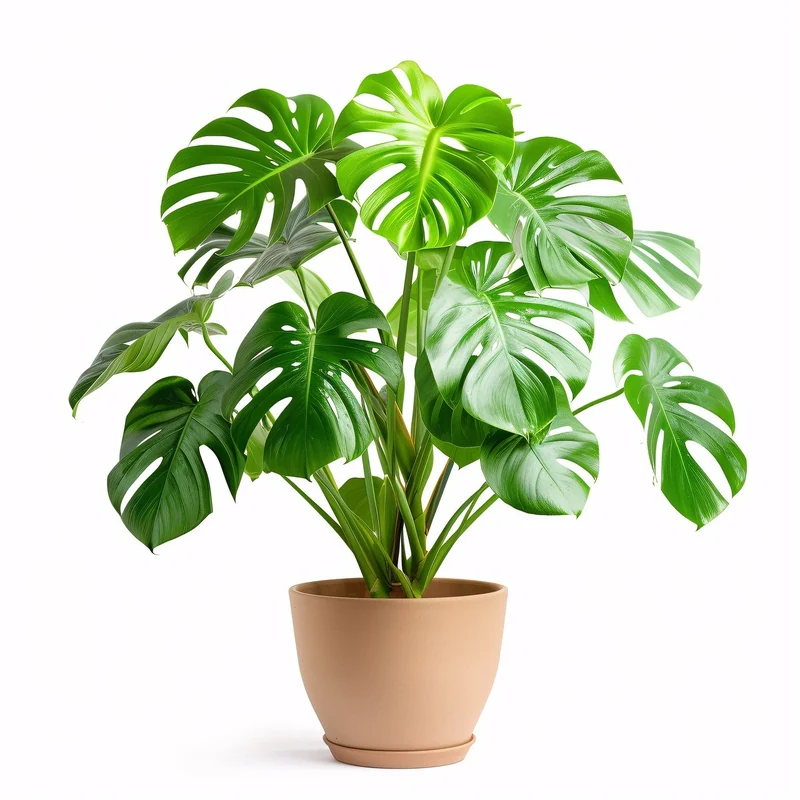
Monstera plants deliver real, measurable benefits — but not all the ones you've read about. Stress reduction, modest humidity gains, and strong biophilic impact are all well-supported. Air purification, by contrast, is wildly overstated. A mature Monstera deliciosa in a bright room genuinely improves the feel of a space. A 4-inch starter pot on a dim desk does almost nothing.
That distinction matters. Most articles treating monstera plant benefits as a flat list — every claim presented with equal confidence — are doing you a disservice. Some benefits are backed by peer-reviewed research. Others are marketing mythology recycled until it sounds like science. This piece separates the two, and gives you specific size and condition thresholds before any benefit actually kicks in.
Thinking about keeping yours indoors year-round? Our guide to monstera plant indoor or outdoor growing covers the trade-offs in detail.
The difference between proven and popular claims
Three benefits hold up to scrutiny across multiple studies: stress reduction through visual exposure, mild humidity contribution from transpiration, and biophilic design impact. One benefit — air purification — is real in principle but requires plant densities no home can achieve. Symbolic and cultural meaning is subjective but psychologically legitimate. That's the honest map.
Why plant size and conditions matter for any benefit
Leaf surface area drives every functional benefit a Monstera offers. Transpiration happens through leaves. VOC absorption happens through stomata on leaves. Visual fascination requires visual mass. An 8-inch pot in bright indirect light has roughly 8–12 mature leaves. A 4-inch starter has 2–3. The difference in functional output is not incremental — it's categorical. Don't buy a small Monstera expecting wellness results. Buy it as a long-term investment and give it 12–18 months to size up.
Air Purification, Humidity, and the Science of What Plants Actually Do
The NASA study — and why your living room isn't a sealed chamber
The NASA Clean Air Study (1989, B.C. Wolverton) is real science. It found that plants including Monstera deliciosa absorbed VOCs like formaldehyde and benzene in controlled chamber conditions. The problem is the conditions. NASA tested sealed, low-ventilation environments — think spacecraft cabins, not a living room with an HVAC system and windows that open on weekends.
According to a 2019 meta-analysis published in the Journal of Exposure Science and Environmental Epidemiology, you would need more than 100 plants per 10 square feet of floor space to achieve meaningful VOC reduction in a normally ventilated room. That's not a typo. Normal air exchange rates dilute VOCs far faster than any realistic plant collection can absorb them.
Monstera does absorb VOCs through its stomata and through soil microbes in its root zone. The mechanism is real. The scale is the problem. For actual air quality improvement, a HEPA air purifier — the Levoit Core 300 runs about $50 and moves 135 CFM — outperforms any number of houseplants by several orders of magnitude.
Bottom line: Monstera is not a meaningful air purifier for most homes. Any air quality benefit is a small bonus, not a reason to buy the plant. If you're comparing Monstera to pothos for air quality specifically, both are roughly equivalent — pothos may edge slightly ahead due to faster growth and higher stomatal density per square foot, but neither moves the needle in a ventilated room.
How much moisture does a Monstera actually release?
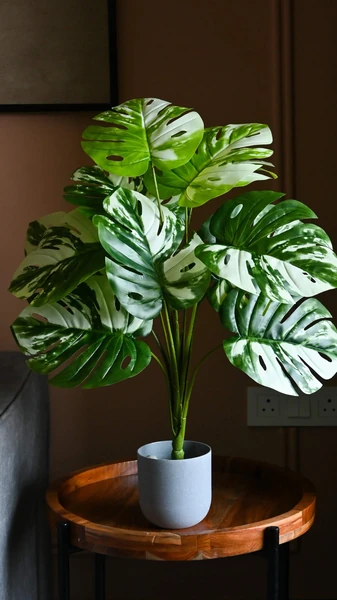
A mature Monstera deliciosa in a 10-inch pot with a healthy root system transpires roughly 1–2 oz of water per day through its large leaf surfaces. That's measurable. It's also modest. A $30 ultrasonic humidifier outputs 200–300 ml per hour. A mature Monstera contributes maybe 30–60 ml per day total.
The humidity benefit is most relevant in dry climates where ambient relative humidity drops below 30%. At those levels, even small gains reduce static electricity, dry skin, and throat irritation. In a humid climate — coastal cities, basements — the contribution is negligible.
Positioning a Monstera near a sunny window increases its transpiration rate by roughly 30–40% compared to a low-light corner, based on stomatal response to light intensity. The fenestrated leaves — those signature holes — are not a liability here. They're an evolutionary adaptation to high-wind tropical forest canopies and don't significantly reduce moisture output per unit of leaf tissue.
Mental Health, Stress Reduction, and Biophilic Design
What the research actually says about plants and stress
This is where Monstera earns its reputation honestly. According to a 2015 study published in the Journal of Physiological Anthropology, interacting with indoor plants — watering, transplanting, pruning — measurably lowered both cortisol levels and self-reported stress compared to equivalent time spent on computer tasks. The effect held across different plant types and age groups.
The theoretical framework behind this is Attention Restoration Theory, developed by Rachel and Stephen Kaplan in 1989. The premise: natural visual patterns trigger what they called involuntary attention, giving the directed attention systems we use for screens and deadlines a genuine rest. It's not relaxation — it's a different neural mode that restores cognitive capacity.
Monstera scores particularly well on the ART component called fascination — the effortless engagement with a visually interesting stimulus. The large, deeply lobed, fenestrated leaves create visual complexity without requiring active decoding. Your brain tracks the pattern without working at it. That's the restorative mechanism.
Is Monstera better for mental health than smaller plants?
Yes, and the reason is quantitative: leaf surface area and visual complexity are both larger. One mature Monstera deliciosa in a work-from-home corner delivers more biophilic impact than a shelf of six small succulents. The succulents have their charm, but they don't generate the same visual mass or fascination response.
Biophilic design — the practice of incorporating natural elements into built environments to support human health — has over 30 years of research behind it. Design schools at Cornell and Harvard both cite large-leaf tropical plants as among the most effective biophilic elements for small interior spaces. Monstera's fenestrated leaves mimic patterns found in natural forest canopies, and researchers have linked these fractal-adjacent patterns to reduced sympathetic nervous system activation.
Practical recommendation for a windowless room: pair a Monstera deliciosa with a quality grow light like the Soltech Solutions Aspect ($150, 1000 lux output at 24 inches). The plant stays healthy, and the visual impact in the space is substantial.
The Toxicity Trade-Off Most Benefits Articles Skip
Every Monstera benefits article should include this section. Most don't. That's a real omission.
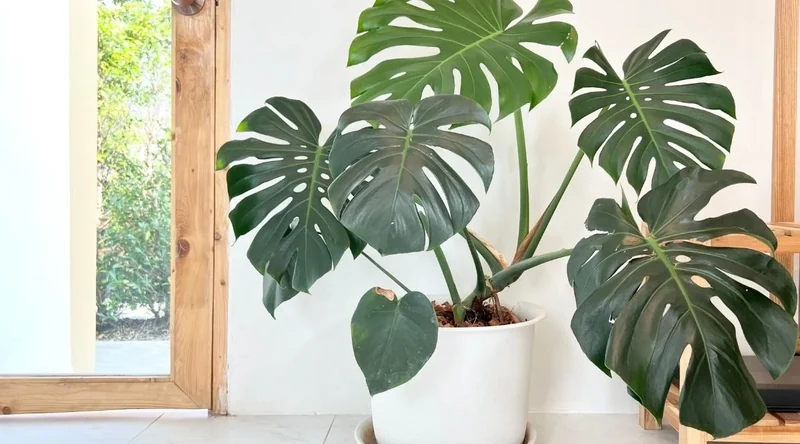
Monstera contains calcium oxalate crystals throughout — leaves, stems, roots, all of it. According to the ASPCA toxic plant database, Monstera is toxic to both cats and dogs. Symptoms of ingestion include oral irritation, excessive drooling, vomiting, and difficulty swallowing. In humans, skin contact with the sap can cause dermatitis in sensitive individuals, and ingesting any quantity causes significant oral discomfort.
None of this eliminates the plant's benefits. But if you have a cat that chews plants — and most cats will investigate anything new — Monstera is the wrong choice regardless of its aesthetic appeal or stress-reduction credentials.
Safe placement strategies and non-toxic alternatives
If you have pets or toddlers and want to keep a Monstera, elevation is the practical solution. Plant stands like the IKEA BITTERGURKA or the Mkono tiered stand get the plant off the floor and out of casual reach. For climbing varieties, ceiling hooks and moss poles can keep foliage well above pet height.
If you'd rather avoid the risk entirely, two alternatives offer similar visual scale without the toxicity:
- Calathea orbifolia — non-toxic, large rounded leaves with striking silver patterning, grows to similar visual mass in a few seasons
- Pilea peperomioides — smaller but non-toxic, interesting leaf geometry, grows quickly in indirect light
- Rhaphidophora tetrasperma — sometimes called "mini Monstera", toxic to pets but much smaller leaves make nibbling less likely; not truly non-toxic, just lower-risk in practice
- Bird of paradise (Strelitzia reginae) — non-toxic, dramatic leaf shape, strong biophilic presence similar to large Monsteras
Which Monstera Species Gives You the Most Benefit?
There are dozens of Monstera species. Three dominate the houseplant market. Here's how they compare on the metrics that actually matter:
| Species | Leaf Size | Growth Rate | Transpiration | Visual Impact | Typical Price (2026) |
|---|---|---|---|---|---|
| Monstera deliciosa | Up to 24–36 in wide (mature) | Fast — 1–2 ft/year indoors | Highest per plant | Very high | $15–$30 (4-in starter) |
| Monstera adansonii | 4–8 in, heavy fenestration | Moderate, vining habit | Low — small leaves | Moderate, trailing | $10–$20 |
| Thai Constellation | Similar to deliciosa | Slow — variegation reduces chlorophyll | Lower than deliciosa | Very high — unique markings | $80–$300 |
Monstera deliciosa wins on every functional metric: largest leaf surface, fastest growth to a size that actually delivers benefits, highest transpiration rate, strongest visual presence. At $15–$30 for a starter, it's also the clear winner on benefit-per-dollar. See our full breakdown of monstera plant price across sizes and sellers if you're shopping right now.
Monstera adansonii (the Swiss cheese vine) makes sense for small spaces or hanging baskets where a full-size deliciosa would overwhelm the room. Its functional benefits are proportionally lower, but it's not a bad plant — just a different tool.
Thai Constellation is worth buying for one reason: it's genuinely beautiful. The creamy variegation is striking. But the variegation means lower chlorophyll density, slower photosynthesis, less VOC absorption per leaf, and slower growth to a functional size. Buy it as art, not as a wellness investment. And budget accordingly — as of April 2026, quality specimens still run $100–$250 at most specialty nurseries.
Practical Tips to Maximize Every Benefit
Minimum requirements before benefits kick in
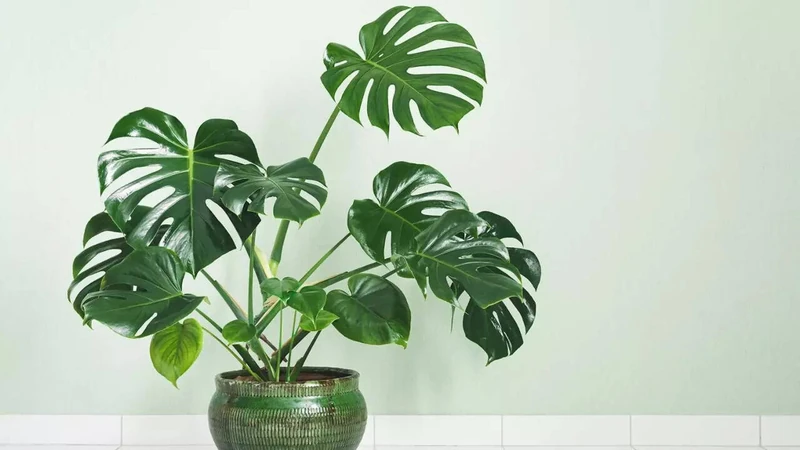
The threshold for measurable benefit from a Monstera is specific: 8-inch pot minimum, bright indirect light at 200 foot-candles or above (measurable with any free lux meter app on your phone), and a consistent watering schedule. Below those thresholds, you're maintaining a houseplant, not gaining a wellness tool.
A stressed plant — yellowing leaves, root rot from overwatering, chronically dry soil — provides essentially zero air quality or humidity benefit and is more likely to add stress than reduce it. Plant care anxiety is a real phenomenon. A struggling plant you can't diagnose reliably defeats the stress-reduction purpose entirely.
Watering, light, and fertilizer for optimal performance
Fertilize monthly during spring and summer with a balanced liquid fertilizer. Jack's Classic 20-20-20 at half-strength is a reliable, inexpensive option. Consistent nutrition drives the vigorous leaf production that underpins every functional benefit — bigger leaves, faster growth, more transpiration surface.
Water when the top 2 inches of soil dry out, not on a fixed calendar schedule. Monstera roots need oxygen. The leading cause of Monstera failure is overwatering, not underwatering. A moisture meter ($10–$15) removes the guesswork entirely.
Real vs. artificial Monstera: does a fake plant offer any of the same benefits?
This is a question more people ask than most plant sites acknowledge. The honest answer: artificial plants do provide some biophilic and aesthetic benefit. Studies show that even photographs of nature produce mild stress-reduction effects, so a high-quality faux Monstera in a visible spot is not worthless. It contributes visual complexity and nature-adjacent pattern to a space.
What it does not do: add any humidity, absorb any VOCs, require any care routine (which itself has proven mental health value for real plants), or develop over time. It also never looks quite right up close, and the novelty of the visual stimulus fades faster than a living plant that changes weekly.
Buy a real Monstera if you can commit to watering once a week and giving it adequate light. Buy a high-quality artificial — Nearly Natural and Pottery Barn both make convincing faux versions — only if you travel more than two weeks per month or have genuinely no natural light source in the space.
Cultural Meaning and Why That's a Legitimate Benefit
In Chinese feng shui, Monstera is associated with longevity and honor. The large, upward-reaching leaves are considered to attract positive energy into a home. In Japan, Monstera imagery appears across art, textile design, and packaging as a symbol of tropical abundance and the exotic.
In Western interiors, Monstera became a mid-century modern icon in the 1950s and '60s, fell out of fashion, then experienced a well-documented resurgence after 2015 tied directly to Instagram interior aesthetics. As of April 2026, it remains one of the most-searched houseplants globally — a cultural staying power few other species match.
This isn't pseudoscience. The psychological benefit of living in a space that feels intentional, aesthetically coherent, and personally meaningful is real. Interior psychologists recognize place attachment — the emotional connection people form with their physical environments — as a genuine component of wellbeing. A Monstera that signals "I curated this space" contributes to that. Dismiss it as trivial and you're missing a documented mechanism.
Frequently Asked Questions
Is Monstera good for sleep?
Indirectly, yes. Monstera's modest transpiration adds small amounts of humidity to a room, and slightly higher humidity (between 40–60% RH) is associated with better sleep quality and reduced nighttime congestion. The stress-reduction effect from visual exposure to plants during waking hours may also improve sleep onset. Place it in a bedroom with bright indirect light during the day — not directly over your bed, given the calcium oxalate toxicity risk if leaves fall. Don't expect it to replace a humidifier or a sleep hygiene routine, but it's a net positive in a dry bedroom environment.
How fast does Monstera grow?
A healthy Monstera deliciosa in bright indirect light and a proper fertilizing schedule grows roughly 1–2 feet per year indoors. Growth is fastest in spring and summer; expect near-dormancy from November through February. Each new leaf emerges as a tightly rolled spear, unfurling over 1–2 weeks. A 4-inch starter plant typically reaches an 8-inch pot size — the threshold for meaningful functional benefits — within 12–18 months with consistent care.
Where should I put a Monstera for the most benefit?
A north- or east-facing window with bright indirect light is ideal for both plant health and benefit delivery. South-facing windows work if the plant is set back 3–4 feet from the glass to avoid leaf scorch. For mental health and biophilic impact specifically, place it at eye level or slightly above in a room where you spend concentrated work or rest time — a home office, living room, or reading corner. Avoid bathrooms unless the light is adequate; low-light bathrooms produce a struggling plant, not a wellness tool.
Can Monstera survive in low light and still be beneficial?
Monstera survives low light. It does not thrive in it. Below 100 foot-candles — typical of interior rooms more than 8 feet from a window — growth slows to 1–2 new leaves per year, transpiration drops significantly, and the plant loses the visual vibrancy that drives biophilic benefit. If your only option is a low-light space, supplement with a grow light. The Soltech Solutions Aspect or a simple clip-on grow bulb (10W minimum, full-spectrum) extends usable hours and keeps the plant in an active growth state.
Is Monstera good for beginners?
Yes — Monstera deliciosa is one of the better beginner plants specifically because it gives clear signals before serious problems develop. Yellowing leaves indicate overwatering. Brown, crispy leaf tips indicate low humidity or underwatering. Leggy, pale new growth indicates insufficient light. Each symptom has an obvious fix. The main beginner mistake is overwatering; if you water only when the top 2 inches of soil are dry, you'll avoid the leading cause of failure. It's a forgiving plant with a clear feedback loop.
Are Monstera plants toxic to cats and dogs?
Yes. According to the ASPCA, Monstera is toxic to both cats and dogs due to calcium oxalate crystals found throughout the plant. Ingestion causes oral irritation, drooling, vomiting, and difficulty swallowing. Symptoms are rarely life-threatening but are genuinely painful for the animal. If you have cats that chew plants, either place the Monstera well out of reach on an elevated stand or choose a non-toxic alternative like Calathea orbifolia, which offers similar large-leaf aesthetics without the toxicity risk.