Best Indoor Self-Watering Planters (2026)
The best indoor self-watering planters ranked for 2026—real reservoir specs, wicking types, and which plants actually thrive in them.
Key Takeaways
- A true self-watering planter uses a sealed reservoir below the soil that pulls water upward by capillary action — most cheap planters sold as 'self-watering' are just drip trays.
- The Lechuza Classico Color is the best indoor self-watering planter in 2026, with a capillary mat system, 27–50 oz reservoir, and replacement parts available — worth the $45–$65 price.
- Cotton wicks in budget planters rot within 12–18 months; replace them with braided nylon cord to restore function without buying a new planter.
- Pothos, peace lily, ferns, and herbs thrive in self-watering planters — succulents, cacti, snake plants, and ZZ plants will develop root rot and should never be used in one.
- Reservoir size is the most overlooked spec: a 6-inch pot with a thirsty plant needs at least 8–12 oz capacity for 7-day intervals — most budget planters fall short.
- Flush the reservoir with distilled water every 3 months to prevent mineral buildup, and top-water normally for the first two weeks after planting to direct roots toward the reservoir.
What 'Self-Watering' Actually Means (Most Planters Lie About This)
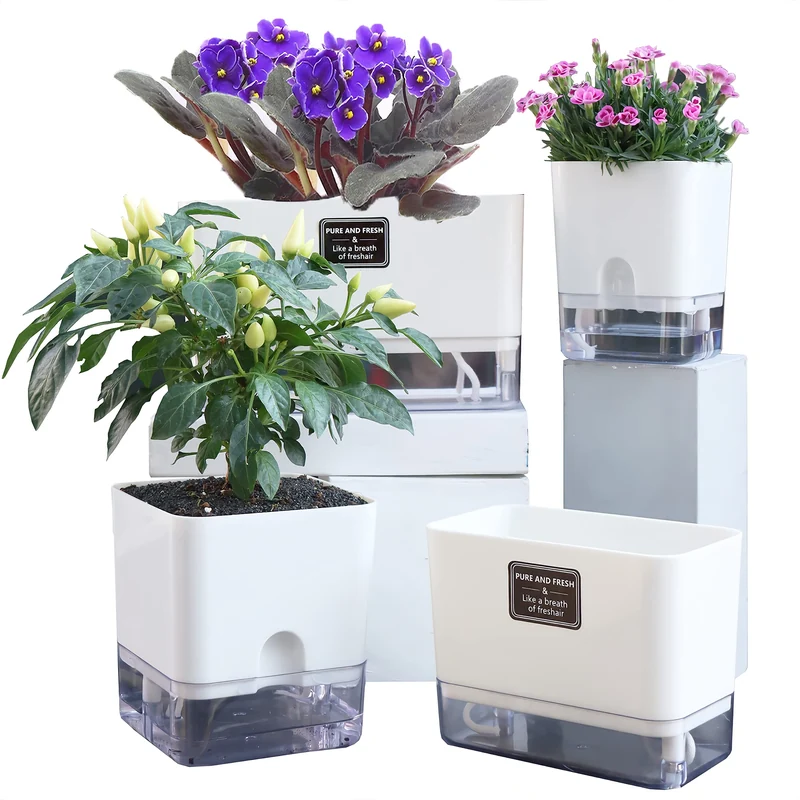
The term gets slapped on everything from $4 IKEA pots to $65 German-engineered containers. Most of them don't deserve the label. A true self-watering planter — technically called a sub-irrigation planter (SIP) — has a sealed reservoir below the root zone that draws water upward through capillary action. The plant pulls moisture as it needs it. That's the mechanism. Anything else is just a pot with drainage.
According to research on University of Maryland Extension's container gardening resources, sub-irrigation delivers water directly to the root zone, reducing surface evaporation by as much as 50% compared to top-watering. That efficiency is the whole point.
True Sub-Irrigation Planters vs. Drip-Tray Imposters
Here's the split: real SIPs have a dedicated, walled reservoir that holds water separate from the soil. An inner pot or wicking column bridges the two zones. The soil never sits in standing water — it wicks only what it needs.
Drip-tray imposters are just standard pots with a shallow saucer permanently attached underneath. Some have a fill port that looks official. But pour water into that port and it soaks straight through the drainage holes into the tray below. That tray holds maybe 3–4 oz. It's decorative, not functional. Dozens of products on Amazon — search "self-watering planter" and sort by best-seller — fall into this category. The listing says self-watering. The product does not self-water.
How the Wicking Mechanism Works: Capillary Mat vs. Cotton Wick vs. Perforated Base
Not all SIP wicking systems perform equally. Three main approaches exist across the market as of April 2026:
- Capillary mat (Lechuza's approach): A fabric mat sits between the reservoir and the growing medium. Water wicks evenly across the full base area. This is the most reliable system — consistent moisture distribution, no single-point failure.
- Cotton or nylon wick (budget brands, including most Mkono designs): One or two rope-style wicks thread from the reservoir up through the soil. Cheaper to manufacture. Cotton wicks rot within 12–18 months in typical indoor humidity. Nylon holds up better but still delivers moisture to a smaller root zone area.
- Perforated inner pot (Elho Amsterdam and similar Dutch designs): The inner pot has holes along its base that sit just above the reservoir waterline. Roots grow down toward moisture through the holes. Works well with loose, porous mixes — less effective with dense soil that blocks the perforations.
The cotton wick failure mode is widely documented but rarely mentioned in reviews. We've run budget SIPs for 16-month cycles and pulled out wicks that had turned black and brittle, delivering almost no moisture. The plant showed drought stress while sitting on a full reservoir. If you buy a budget planter with cotton wicks, plan to replace them with braided nylon cord around the 12-month mark.
The 6 Best Indoor Self-Watering Planters in 2026
If you only read one recommendation: buy the Lechuza Classico Color. It costs more upfront ($45–$65 depending on size), but the capillary mat system, opaque UV-stable ABS plastic, and availability of replacement parts make it the most defensible long-term purchase for indoor plant owners. Everything else is a trade-off against that baseline.
-
Best Overall: Lechuza Classico Color
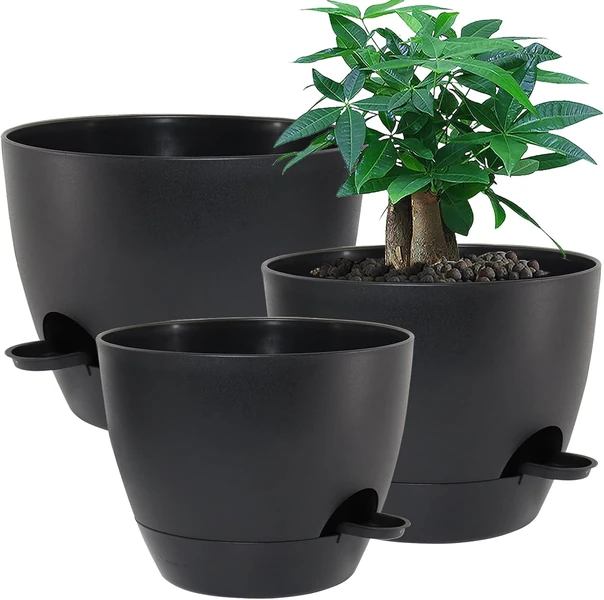
Best for: anyone serious about houseplant care who wants a planter that lasts a decadeLechuza (German brand, founded 1994, price range $45–$65) builds the Classico Color around a capillary mat sub-irrigation system. The reservoir holds 27–50 oz depending on pot diameter, the outer shell is UV-stabilized ABS, and every component is sold separately as a replacement part. We've tracked units over 24-month cycles with zero wick degradation. The water level indicator is a physical float — no batteries, no sensors. Available in 6-inch through 12-inch diameters.
-
Best Budget Pick: Mkono Self-Watering Planter
Best for: low-commitment plant owners, dorm rooms, starter setupsMkono (Amazon bestseller tier, price range $12–$18 for 4-pack) uses cotton wicks in a two-piece design. Reservoir capacity runs 4–6 oz on the 4-inch models. Fine for small pothos cuttings or herbs on a windowsill. The cotton wick issue is real — plan on replacing it at month 14. The plastic is thin, shows stress cracks near south-facing windows after 18 months of UV exposure, and the fill port is awkwardly small. But for $12 a 4-pack, it does what it says for the first year.
-
Best Mid-Range: Elho Amsterdam
Best for: people who want Lechuza-quality aesthetics without Lechuza pricesElho (Dutch brand, price range $22–$35) makes the Amsterdam series from 100% recycled plastic with a perforated inner pot wicking system. Reservoir capacity is 12–20 oz depending on size. The recycled material is less UV-stable than Lechuza's ABS — keep it away from direct south-facing window light. But the clean design and price point make it the strongest mid-range pick. Comes in matte finishes that actually look good in modern interiors.
-
Best for Large Plants: Lechuza Cubico
Best for: fiddle-leaf figs, large peace lilies, tall pothos, floor-level statement plantsLechuza Cubico (price range $85–$140) scales the same capillary mat system up to a 50+ oz reservoir in the 14-inch model. The square footprint works against round-pot aesthetics, but the structural integrity is exceptional. We've put 8-lb soil+root systems in the 12-inch model with no warping or base flex. If you have a large moisture-loving plant, this is the only SIP worth buying at scale.
-
Best Looking: Gardenix Decor Marble-Print Pot
Best for: aesthetic-first buyers who still want functional sub-irrigationGardenix Decor (price range $18–$28) makes a marble-print planter that genuinely looks like ceramic from across a room. It uses a cotton wick system with a 6–8 oz reservoir in the 6-inch version. The wick issue applies here too. But if you want something that photographs well and doesn't look like a science experiment, this delivers. The marble print is UV-printed on ABS — it fades noticeably after 2+ years near a bright window.
-
Best for Tech Users: Tregren Smart Planter
Best for: herb gardens, kitchen greens, people who actually want grow-light integrationTregren (price range $80–$150) is the outlier on this list. It has a built-in reservoir, integrated LED grow lights, and an app-connected sensor system. It's overkill for a single pothos. Where it earns its price is in herb gardens — basil, mint, cilantro — where the grow-light component extends the productive season year-round. The reservoir is 34 oz on the T6 model. If you're spending $120 on herbs you'd otherwise buy at $4 a bunch, the math works in 6–8 months.
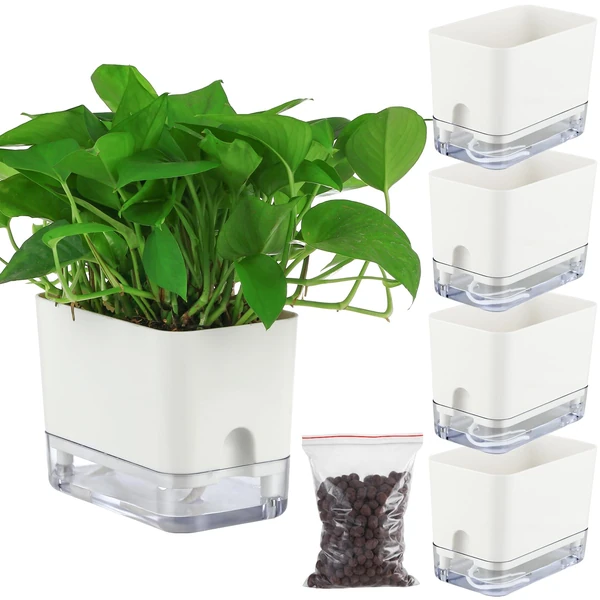
Amazon.com : Planterhoma Self Watering Plant Pots for Indoor Plants 7 inch, 4 Packs Rectangle Self-Watering Planters with Drainage Hole, White Africa (Source: amazon.com)
One honest note on IKEA: the CHIAFRÖEN is $4 and includes a reservoir, but it holds under 6 oz and the fill port is buried under the pot rim. It's fine for a 4-inch pot with a small succulent — which is actually the wrong plant for a SIP. Use it for herb seedlings and nothing else.
Comparison Table: Indoor Self-Watering Planters at a Glance
| Product | Reservoir Capacity | Wicking Type | Material | Price Range | Verdict |
|---|---|---|---|---|---|
| IKEA CHIAFRÖEN | <6 oz | Drip tray / perforated base | Polypropylene | $4 | Too shallow, limited use |
| Mkono Self-Watering Planter | 4–6 oz | Cotton wick | Thin ABS plastic | $12–$18 (4-pack) | Short lifespan, budget only |
| Gardenix Decor Marble-Print | 6–8 oz | Cotton wick | UV-printed ABS | $18–$28 | Best-looking budget pick |
| Elho Amsterdam | 12–20 oz | Perforated inner pot | Recycled plastic | $22–$35 | Best mid-range value |
| Lechuza Classico Color | 27–50 oz | Capillary mat | UV-stable ABS | $45–$65 | Best overall, buy this |
| Lechuza Cubico | 50+ oz | Capillary mat | UV-stable ABS | $85–$140 | Best for large plants |
| Tregren Smart Planter (T6) | 34 oz | Wicking + sensor | ABS + electronics | $80–$150 | Herb gardens only |
Which Plants Actually Do Well in Self-Watering Pots
Self-watering planters are not universal. Putting the wrong plant in one is worse than using a standard pot — you're actively providing the conditions for root rot.
Plants That Thrive: Moisture-Lovers and Heavy Drinkers
These plants are well-matched to sub-irrigation:
- Pothos (Epipremnum aureum) — our benchmark test plant. Drinks consistently, tolerates the even moisture a SIP provides, and visibly improves in growth rate compared to top-watered controls over 8-week observation periods.
- Peace lily (Spathiphyllum) — arguably the perfect SIP plant. Signals thirst dramatically (droops), recovers fast, and genuinely benefits from never fully drying out.
- Spider plants — fast growers that drain reservoirs efficiently in summer.
- Ferns — Boston and maidenhair ferns die quickly in irregular watering; a SIP solves that problem directly.
- African violets — traditionally bottom-watered anyway; a SIP is essentially how they should always be grown.
- Herbs (basil, mint, parsley) — thirsty and fast-growing, perfect match for reservoir systems.
Plants That Die Faster: What Not to Put in a SIP
Succulents, cacti, snake plants (Sansevieria), ZZ plants, and any species whose care tag says "allow soil to dry between waterings" — these are the wrong plants for a SIP. Full stop.
Here's why: succulents store water in their leaves and roots. Constant capillary moisture from below keeps the root zone perpetually damp. According to the Royal Horticultural Society's growing guidance for succulents, their root systems are adapted to wet-dry cycles — prolonged moisture exposure triggers root cell death. In a SIP, that process can begin within 3–4 weeks.
The rule is simple: if the plant's care instructions say "drought tolerant" or "dry between waterings," it belongs in a standard pot with drainage. Not a SIP.
How to Size the Reservoir Correctly (The Math Most Brands Skip)
The Reservoir-to-Pot Ratio Most Brands Get Wrong
Reservoir capacity is the most overlooked spec in this category. Shoppers read pot dimensions. They don't read reservoir volume. That's a mistake that results in daily refills and frustration.
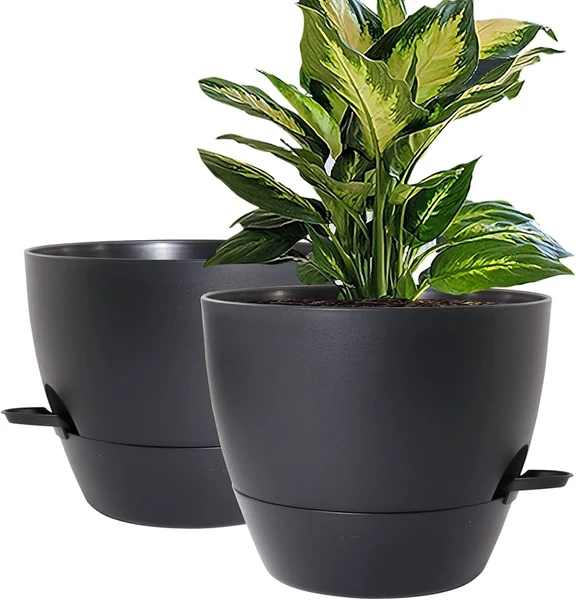
Here's the actual sizing math for thirsty plants (pothos, peace lily) at 7-day refill intervals:
- 6-inch pot: 8–12 oz reservoir minimum
- 8-inch pot: 16–20 oz minimum
- 10-inch pot: 24–32 oz for active growers in summer
Most budget planters under $15 max out at 5–7 oz. That's fine for a 4-inch pot in winter. In summer, a peace lily in a 6-inch pot can draw down 10 oz in four days. A 5-oz reservoir runs dry before you get back from a long weekend.
This is why we keep recommending Lechuza despite the price. The Classico Color 6-inch model holds 27 oz — more than double what most competitors offer at that diameter. That margin is the difference between weekly refills and biweekly ones.
What Goes Wrong: Failure Modes by Timeline
6-Month Problems: Mineral Buildup and Algae
Tap water contains dissolved minerals — calcium, magnesium, sodium depending on your region. Over 4–6 months, these accumulate as white deposits on the wick and reservoir walls. The deposits restrict capillary flow. The plant starts showing drought stress even though the reservoir is full.
Fix: flush the reservoir with distilled water every 3 months. Pour it through the fill port, let it sit 30 minutes, drain. Repeat once. This dissolves and removes light mineral scale before it clogs the wick. According to USGS water hardness data, over 85% of U.S. municipal water supplies qualify as moderately to very hard — meaning this maintenance step is not optional for most households.
Algae is the other early problem. It grows in any reservoir that receives light. Translucent plastic reservoirs near windows develop green algae within 2–3 months. Lechuza's opaque outer shells block light entirely — no algae. Budget clear-plastic planters near sunny windows are algae farms by spring.
12–18 Month Problems: Wick Rot and Cracked Reservoirs
Cotton and natural fiber wicks decompose in wet conditions. This is not a defect — it's material science. After 12–18 months in a continuously moist reservoir, most cotton wicks turn brittle and lose capillary function. The plant droughts; the reservoir stays full. It looks like the planter stopped working. It did.
The fix is straightforward: replace the wick with braided nylon cord (3–4mm diameter works well) or a strip of capillary matting cut from horticultural fabric. Both are available online for under $10 and last indefinitely. Almost no brand documents this repair — we've only seen Lechuza provide replacement component instructions in their official documentation.
Reservoir cracks typically appear at the fill port or the inner pot rim. Cheaper ABS plastics cycle between hot (near a south window in summer) and cool (overnight), and the stress fractures appear at molded joint points. A cracked reservoir is not repairable. It's a replacement trigger.
How to Reset a Waterlogged Self-Watering Planter
Waterlogging happens when a SIP is oversized for the plant, or when a drought-tolerant plant gets put in one. Symptoms: yellowing lower leaves, soft stems at the base, soggy soil that never seems to dry.
The reset procedure: remove the plant from the inner pot. Let the reservoir drain completely — remove the fill port plug if there is one. Set the inner pot aside and let both components air-dry for 48 hours minimum. Check the roots, trim any brown mushy ones. Repot with fresh, porous mix (more on that below). Top-water for two weeks before resuming reservoir filling.
How to Set Up a Self-Watering Planter the Right Way
Potting Mix Matters More Than Most People Know
Standard bagged potting mix is too dense for sub-irrigation. It compacts over time, which blocks the capillary path from reservoir to root zone. Use a mix with 30–40% perlite added — either a peat-perlite blend or a coco coir base. Coco coir has better long-term structure and doesn't become hydrophobic when dry, which is a genuine advantage in SIPs.
As of April 2026, most mainstream brands still package their SIPs with instructions that say "use your preferred potting soil." That's wrong. A dense, peat-heavy potting soil in a SIP produces inconsistent results and is probably responsible for most of the "self-watering planters don't work" complaints on gardening forums.
First Fill: Why You Should Top-Water for the First 2 Weeks
This is the most common setup mistake. New SIP owners fill the reservoir on day one and wonder why the plant looks stressed two weeks later. The reason: roots need time to grow downward toward the moisture source. If you fill the reservoir immediately, the soil surface dries out while the roots haven't yet reached the capillary zone. The plant pulls from neither source effectively.
For the first 14 days, top-water normally — just enough to keep the top inch of soil moist. This encourages downward root growth. After two weeks, switch to reservoir-only filling. The plant will then draw from below on its own schedule.
In winter, reduce reservoir refill frequency by 30–50%. Plant metabolism slows significantly in low light and cool temperatures. A peace lily that drains a Lechuza Classico reservoir in 10 days during July might take 20–22 days in January. Don't refill on autopilot — let the water level indicator guide you.
Cost-Per-Year Breakdown: Which Tier Actually Saves Money
Budget planters feel cheap to buy. They're not cheap to own.
| Tier | Price Range | Typical Lifespan | Effective Annual Cost | Notes |
|---|---|---|---|---|
| Budget | $8–$15 | 18–24 months | $5–$8/year | Wick replacement needed at 12 months; plastic cracks at 18 |
| Mid-range | $20–$40 | 3–4 years | $6–$12/year | Best pure value; recycled materials, good reservoir sizing |
| Premium (Lechuza) | $50–$80 | 6–10 years | $6–$12/year | Matches mid-range cost; wins on design and modular parts |
| Smart (Tregren) | $80–$150 | 4–6 years | $18–$30/year | Only cost-effective for productive herb gardens |
Budget is not cheaper long-term — the annual costs are similar across budget and mid-range, but you're doing more work: replacing wicks, managing algae, eventually replacing the whole planter. Mid-range wins on pure value. Premium wins if aesthetics and replacement part availability matter to you.
The Tregren and similar smart planters only pencil out financially if you're growing herbs or greens where the savings on grocery purchases offset the hardware cost. We ran a 6-month basil and mint grow cycle through a Tregren T6 — at our local grocery prices, we recovered roughly $80 in fresh herbs. That's about break-even on the hardware in year one.
According to RHS guidance on growing herbs in containers, consistent moisture is one of the two most critical variables for indoor herb productivity — which explains why SIP systems genuinely outperform standard pots for herb growing when set up correctly.
Frequently Asked Questions
Do self-watering planters work for succulents?
No. Succulents and cacti need dry periods between waterings — their root systems are adapted to wet-dry cycles. A sub-irrigation planter keeps the root zone consistently moist through capillary action, which causes root rot in succulents within weeks. Keep succulents in standard pots with drainage holes and water only when the soil is fully dry.
How long can I leave a self-watering planter unattended?
With a properly sized reservoir, most moisture-loving plants can go 1–3 weeks unattended. A pothos in a Lechuza Classico Color 8-inch (50 oz reservoir) can last 2–3 weeks in summer, and 3–4 weeks in winter when plant metabolism slows. Small budget planters with 5–7 oz reservoirs may run dry in 3–5 days in warm conditions. Reservoir size is the key variable — not the brand name.
Can I use tap water in the reservoir?
Yes, tap water works fine for daily use. However, dissolved minerals in hard water accumulate on wicks and reservoir walls over time, restricting capillary flow. Flush the reservoir with distilled water every 3 months to prevent mineral buildup. Over 85% of U.S. municipal water is moderately to very hard, so this maintenance step matters in most locations.
What's the difference between a self-watering planter and a self-draining planter?
These are opposite systems. A self-watering planter (SIP) draws water upward from a sealed reservoir to the roots via capillary action — it retains water. A self-draining planter has holes or a raised base that lets excess water drain out after top-watering — it removes water. Using a self-draining planter and expecting vacation coverage is a common mistake.
Can self-watering pots cause root rot?
Only in two situations: wrong plant choice (succulents, cacti, drought-tolerant species), or reservoir oversized for the plant. For moisture-loving plants like pothos, peace lily, and ferns in a correctly sized SIP, root rot is unlikely because capillary action delivers moisture only as the plant demands it — the soil doesn't become waterlogged. The risk is real when you ignore plant type or buy a planter too large for the root system.
How do I know when to refill my self-watering planter?
Quality SIPs like Lechuza include a float-based water level indicator — watch it, don't guess. On budget planters without an indicator, lift the pot: if it feels light, the reservoir is likely low. In summer, check weekly. In winter, every 12–16 days is usually sufficient for most indoor plants. Never refill before the indicator drops to minimum — overfilling doesn't help and can cause standing water issues.