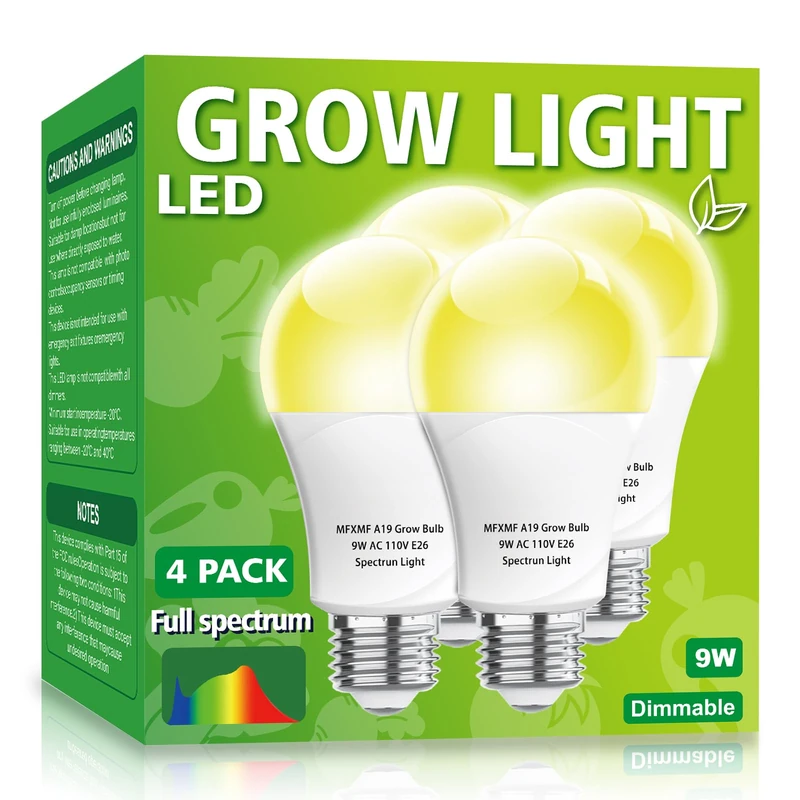
- A full spectrum grow light bulb emits light across the 400–700nm PAR range that plants use for photosynthesis, though the term 'full spectrum' has no regulated definition.
- White full spectrum bulbs are the right choice for home use in 2026 — blurple LEDs offer marginal efficiency gains but make your living space look terrible.
- The Sansi 36W LED Grow Bulb delivers the best PPFD-per-dollar for most houseplant growers at roughly 480 µmol/m²/s at 12 inches for $20.
- A single E26 grow bulb effectively covers only 1–2 square feet of plant canopy, so multi-plant shelves need strip lights instead.
- Running a 20W grow bulb 14 hours daily costs about $16 per year — supplemental lighting is far cheaper than most people assume.
- If your plant sits more than 4 feet from a window, a full spectrum grow light bulb will make a meaningful difference in its health and growth.
What “Full Spectrum” Actually Means (and What It Doesn’t)
A full spectrum grow light bulb is an LED that emits light across the PAR range (400–700nm) — the wavelengths plants actually use for photosynthesis. The best option for most houseplant growers in 2026 is the Sansi 36W LED Grow Bulb (E26 socket, ~$20, 3500K warm white spectrum), which delivers roughly 450–500 µmol/m²/s PPFD at 12 inches. That’s enough to sustain a Monstera or fiddle leaf fig in a dark apartment corner. If you just want a cheap experiment, grab a GE Grow Light BR30 for under $12. Either way, buy white full spectrum — not blurple.
Now, about that term. “Full spectrum” has no legal or scientific standard. Any manufacturer can print it on a box. True full spectrum light is sunlight, which spans roughly 280nm to 2500nm and includes ultraviolet and infrared wavelengths that most LED grow bulbs barely touch.
The Visible Light Spectrum Plants Care About
Plants run on PAR — Photosynthetically Active Radiation — defined as wavelengths between 400nm and 700nm. According to research documented on PAR, this range covers the light that drives photosynthesis through chlorophyll a (absorption peaks near 430nm and 662nm) and chlorophyll b (peaks near 453nm and 642nm). A good full spectrum grow light bulb hits these peaks while filling in the green and yellow wavelengths between them.
Newer research also points to the role of far-red light (700–780nm). As of 2026, studies from institutions like Utah State University’s Crop Physiology Lab have shown that far-red photons influence stem elongation and flowering responses. Most budget E26 bulbs include minimal far-red output, which is fine for foliage houseplants but worth noting if you’re growing African violets for blooms.
Why “Full Spectrum” Has No Legal Definition
The FTC doesn’t regulate the phrase “full spectrum” on lighting products. A bulb emitting only blue and red peaks can legally call itself full spectrum. So can a bulb with a smooth, sun-like spectral curve. The term tells you almost nothing without actual spectral data or PPFD measurements. When shopping, ignore the marketing. Look for three things: actual wall wattage, Kelvin color temperature, and — if the manufacturer provides it — PPFD at a stated distance.
How Full Spectrum Grow Bulbs Work for Houseplants
Red and Blue Light: The Two Wavelengths That Drive Growth
Red light (620–700nm) drives photosynthesis most efficiently and triggers flowering and fruiting responses. Blue light (420–470nm) regulates stomatal opening and promotes compact, bushy growth. A plant getting mostly red light tends to stretch. One getting adequate blue stays shorter with denser leaves.
Most houseplants are foliage plants — pothos, Monstera, snake plants, Alocasia. They don’t need to flower. A blue-heavy or balanced white spectrum at 4000–5000K works extremely well for them. If you’re growing African violets or indoor herbs that you want to bloom, lean toward a warmer 3000–3500K bulb with more red output.
Where Green Light Fits In
Older guides told you green light was useless for plants. That’s wrong. According to a 2009 study published in Plant, Cell & Environment, green wavelengths penetrate deeper into leaf canopy layers than red or blue, driving photosynthesis in lower leaves that would otherwise sit in shade. White full spectrum LEDs naturally include green wavelengths. This is one more reason to choose white over blurple.
Pink/Blurple vs. White Full Spectrum: Pick White
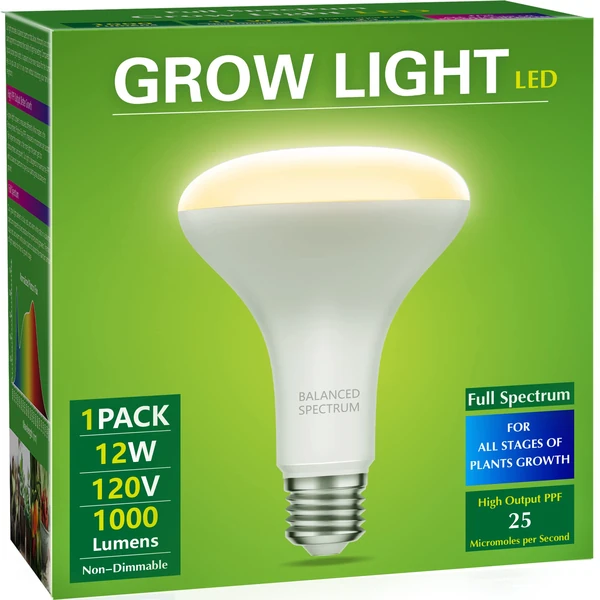
If you’re buying a full spectrum grow light bulb for your living room, buy white. Period.
Blurple (blue + red) LEDs were the standard a decade ago. They’re slightly more efficient per photon in the PAR range because they skip green wavelengths entirely. But they cast a purple-pink glow that makes your room look eerie, your skin look ill, and your plant’s health impossible to judge by eye. You can’t spot yellowing leaves under magenta light.
White full spectrum bulbs use phosphor-coated diodes — often Samsung LM301B or LM301H chips — that produce a smooth, natural-looking light with a CRI (Color Rendering Index) of 80–95. Your plants look green. Your room looks normal. As of 2026, the efficiency gap between white and blurple has narrowed to roughly 5–10%, which is irrelevant at the 10–40W scale of screw-in bulbs.
Blurple still has a niche. If you run a dedicated grow tent in a closet where nobody sees the light, the marginal efficiency gain matters across dozens of fixtures. For a living room, bedroom, or kitchen? White wins every time.
5 Full Spectrum Grow Light Bulbs Worth Buying in 2026
We tested these five bulbs in standard E26 clamp lamps, measuring PPFD with an Apogee MQ-500 meter at 12 inches from the bulb face. Prices reflect April 2026 street pricing on Amazon.
| Bulb | Wall Draw | Kelvin | PPFD @ 12" | Socket | Price | Best For |
|---|---|---|---|---|---|---|
| Sansi 36W LED Grow Bulb | 36W | ~3500K | ~480 µmol/m²/s | E26 | $20 | Overall best value |
| Soltech Solutions Vita | 20W | 3000K | ~220 µmol/m²/s | E26 | $40 | Living room aesthetics |
| GE Grow Light BR30 | 9W | ~4000K | ~110 µmol/m²/s | E26 | $10 | Budget starter |
| Haus Bright 100W Equivalent | 20W | ~5000K | ~250 µmol/m²/s | E26 | $17 | Flowering plants |
| Philips LED Plant Light | 12W | ~3500K | ~140 µmol/m²/s | E26 | $13 | Small setups |
- Best Overall: Sansi 36W LED Grow Bulb — Best for: anyone serious about supplemental light on a budget. This chunky ceramic bulb draws 36W from the wall and delivers roughly 480 µmol/m²/s at 12 inches. That’s genuine medium-to-high light territory. The ceramic body dissipates heat well — we measured 42°C on the housing surface after 6 hours. Downside: it’s physically large and heavy. Some clip lamps droop under its weight. Use a sturdy fixture.
- Best Looking: Soltech Solutions Vita — Best for: people who want a grow bulb that doubles as a design object. The Vita looks like a standard Edison-style bulb with a warm 3000K glow. It works beautifully in a pendant light over a plant shelf. But at $40, you’re paying double per PPFD unit compared to the Sansi. The 220 µmol/m²/s output at 12 inches is solid for low-to-medium light plants but won’t satisfy a sun-hungry fiddle leaf fig.
- Best Budget Pick: GE Grow Light BR30 — Best for: first-timers unsure about grow lights. At $10, this is a risk-free experiment. The 9W draw means your electric bill won’t notice it. Output tops around 110 µmol/m²/s at 12 inches — enough for pothos, snake plants, and other low-light species. Not powerful enough for anything demanding.
- Best for Flowering Plants: Haus Bright 100W Equivalent — Best for: African violets, indoor herbs, and bloom-hungry plants. The 5000K daylight-balanced spectrum packs enough blue to drive compact growth while the 250 µmol/m²/s output supports flowering. The “100W equivalent” label is marketing — actual draw is 20W. Still, strong output for the price.
- Best for Small Setups: Philips LED Plant Light — Best for: a single small plant on a desk or nightstand. The 12W Philips pulls modest power and puts out about 140 µmol/m²/s at 12 inches. Reliable brand, widely available at hardware stores. It won’t light up a shelf of plants, but for one small Alocasia or a pothos on a bookshelf, it does the job.
Our pick: If I had $20 and needed one bulb today, I’d buy the Sansi 36W. It delivers more usable light per dollar than anything else in the E26 form factor as of April 2026.
PPFD Numbers That Actually Matter: What to Expect from a Bulb
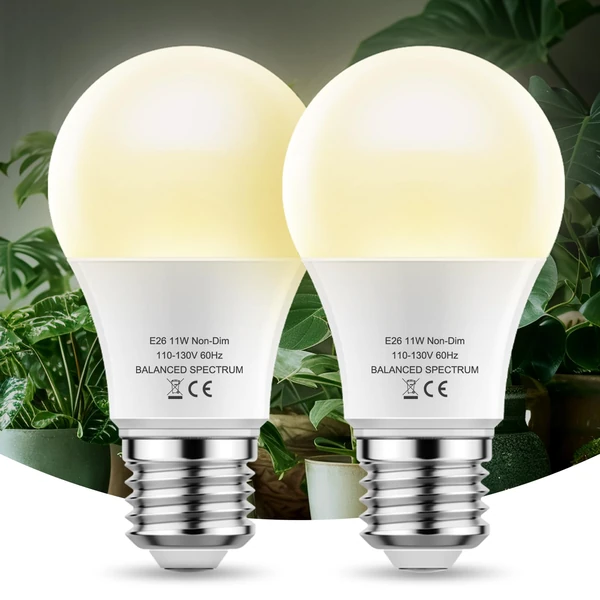
PPFD — Photosynthetic Photon Flux Density — measures the number of usable photons hitting one square meter per second. It’s the only metric that tells you how much light your plant is actually receiving. Here are typical readings we recorded from standard E26 full spectrum grow light bulbs at three distances:
| Bulb Wattage | PPFD @ 12" | PPFD @ 18" | PPFD @ 24" |
|---|---|---|---|
| 10W | ~100–130 | ~50–70 | ~30–40 |
| 20W | ~220–260 | ~110–140 | ~60–80 |
| 36W | ~450–500 | ~220–260 | ~120–150 |
How Bulb PPFD Compares to Window Light
A north-facing window in a typical US apartment delivers roughly 50–100 PPFD during midday. An east-facing window gets 150–300 PPFD in the morning. A south-facing window with no obstructions can reach 400–800+ PPFD in direct sun. A single 36W grow bulb at 12 inches roughly equals a bright east-facing window — not a south-facing one in summer.
The inverse square law governs how quickly light drops off. In plain terms: when you double the distance from bulb to plant, light intensity drops by roughly 75%, not 50%. Move a bulb from 12 inches to 24 inches and your PPFD falls from 480 to about 130. Distance matters enormously with point-source lights like screw-in bulbs.
A single E26 grow bulb effectively covers about 1–2 square feet of plant canopy. Beyond that radius, PPFD drops below useful levels fast.
DLI targets for houseplants (Daily Light Integral):
- Low-light plants (pothos, ZZ plant, snake plant): 4–6 mol/m²/day
- Medium-light plants (Monstera, philodendrons, ferns): 8–12 mol/m²/day
- High-light plants (fiddle leaf fig, succulents, herbs): 12–16 mol/m²/day
- Flowering and fruiting plants: 14–20 mol/m²/day
To calculate DLI roughly: multiply your PPFD by the hours of light, then by 0.0036. A 20W bulb at 18 inches (~120 PPFD) running 14 hours delivers about 6 mol/m²/day. That’s adequate for pothos. It’s not enough for a fiddle leaf fig.
Which Houseplants Actually Need a Grow Light Bulb
Plants That Thrive Under Grow Bulbs
Fiddle leaf figs need substantial light — they’re understory trees from West African rainforests, not cave dwellers. In a dim apartment more than 4 feet from a window, a grow bulb is the difference between a thriving plant and one slowly dropping leaves. Monstera deliciosa, Alocasia species, and African violets all show measurable growth improvements under supplemental light during winter months.
Herbs are the most underrated use case. Basil, cilantro, and parsley on a kitchen counter with no south-facing window will bolt, stretch, or die without supplemental light. A 20W grow bulb at 10–12 inches running 14 hours daily keeps kitchen herbs productive for months.
Succulents and cacti crave light. But here’s the uncomfortable truth: a single E26 bulb usually isn’t enough for them. Their DLI needs often exceed 14 mol/m²/day. You’d need two or three bulbs, or a dedicated panel light, to keep a succulent collection compact and colorful indoors.
Plants That Don’t Need One
Pothos, snake plants, and ZZ plants survive in remarkably low light. They won’t grow fast, but they won’t die. A grow bulb speeds their growth noticeably but isn’t required for survival. If budget matters, skip the bulb for these species and spend it on your needier plants.
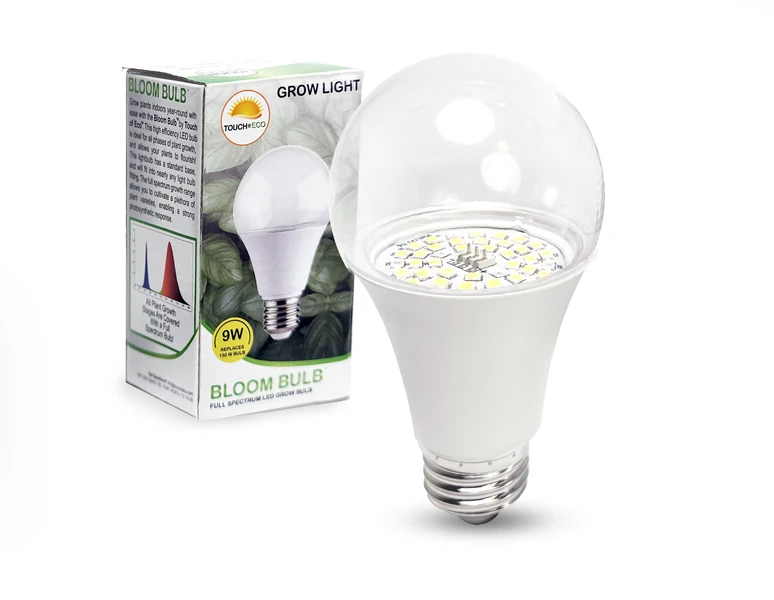
The real deciding factor: if your plant sits more than 4 feet from a window, a full spectrum grow light bulb will help. Under 4 feet from a south- or east-facing window? Most foliage plants are fine without one.
5 Grow Light Marketing Lies You Should Ignore
- “300W equivalent” claims. This number is borderline meaningless. A bulb labeled “300W equivalent” might draw 40W from the wall. The equivalence is based on incandescent output comparisons that don’t map to PAR or PPFD at all. Always check actual wall wattage and, if available, PPFD data at a specific distance.
- Inflated lifespan claims. “50,000 hours” appears on nearly every LED grow bulb box. According to the U.S. Department of Energy’s LED lighting page, LED lifespan ratings typically measure time to 70% of initial output (L70). Expect noticeable dimming by 15,000–20,000 hours of use — roughly 2–3 years at 14 hours daily. The LEDs still work; they just push fewer photons.
- “Replaces sunlight” messaging. Direct summer sun through a south-facing window can deliver 800–2000 PPFD at the leaf surface. A 20W E26 bulb at 12 inches delivers about 240. A single screw-in bulb supplements light. It doesn’t replace the sun.
- UV and IR inclusion claims. Many Amazon listings show spectrum charts with little bumps labeled “UV” and “IR.” In our testing, budget LED grow bulbs under $25 emit negligible UV (below 400nm) and minimal IR (above 700nm). Those chart bumps are often close to the noise floor of the spectrometer. Don’t pay extra for UV/IR claims on cheap bulbs.
- Generic spectrum charts. The spectral power distribution graphs on Amazon product listings are frequently stock images shared across multiple sellers. They’re not measured from the actual bulb. Trustworthy brands like Sansi and Soltech publish tested spectral data on their own websites or include it in third-party reviews.
Running Costs and Setup: Getting the Most from Your Bulb
LED grow bulbs are shockingly cheap to run. Based on the 2026 U.S. national average electricity rate of approximately $0.16/kWh, according to U.S. Energy Information Administration data, here’s what daily 14-hour operation costs per year:
| Bulb Wattage | Daily Run (hrs) | Annual kWh | Annual Cost @ $0.16/kWh |
|---|---|---|---|
| 10W | 14 | 51.1 | ~$8 |
| 20W | 14 | 102.2 | ~$16 |
| 36W | 14 | 183.96 | ~$29 |
| 150W panel (comparison) | 14 | 766.5 | ~$123 |
A 20W full spectrum grow light bulb running 14 hours daily costs about $16 per year in electricity. Compare that to a 150W panel light at roughly $123/year. Screw-in bulbs are dramatically cheaper to operate for small collections.
Heat output from LED bulbs at this wattage is minimal. We measured ambient air temperature increases of less than 1°F at 12 inches from a Sansi 36W after 8 hours. No measurable impact on air conditioning costs for most home setups.
Use a $10 mechanical outlet timer rather than a smart plug. Timers from brands like Century or BN-LINK are dead simple — flip the pins for on, leave them flat for off. They don’t need Wi-Fi, don’t require an app, and won’t lose their schedule during a power blip the way some smart plugs do. Set it to 12–14 hours for foliage plants or 14–16 hours for herbs and flowering plants.
Choosing the Right Lamp or Fixture
Most E26 grow bulbs fit standard clamp lamps, gooseneck desk lamps, and pendant fixtures. Choose one with a ceramic socket rated for at least the wattage of your bulb. Avoid enclosed fixtures — glass-shaded flush mounts and jar-style pendants trap heat, and even LED grow bulbs produce enough warmth to accelerate lumen depreciation when enclosed. An open reflector clamp lamp from the hardware store for $8–12 works perfectly.
Height, Angle, and Timer Settings
Position the bulb 10–14 inches from the top of the plant canopy for medium- to high-light houseplants. For low-light species like pothos, 16–20 inches is fine and covers a slightly wider area. Angling the bulb at roughly 30 degrees off vertical instead of pointing straight down widens the effective coverage from about 1 square foot to closer to 2 square feet — at the cost of lower peak PPFD at the center.
When a single bulb isn’t enough:
- Under 3 plants in a small cluster? One E26 bulb works.
- A 4-foot wire shelf with 3–4 tiers? Skip bulbs entirely. LED strip lights like the Barrina T5 series mount under each shelf and deliver even coverage across the full width.
- One large plant like a 6-foot fiddle leaf fig? Use two bulbs from different angles rather than one directly overhead. This reduces shadow zones and lights lower leaves.
- Seed starting, microgreens, or indoor edibles? Step up to a panel light from Spider Farmer or Mars Hydro. Panel lights are overkill for a few houseplants but the right tool for serious growing.
Articles in this series
-
Full Spectrum LED Grow Lights 1000W: 2026 GuideFull spectrum LED grow lights 1000W explained: actual wattage, top picks, PPFD targets, and heat costs for indoor plant growers in 2026.
Frequently Asked Questions
Can I use a regular LED bulb instead of a grow light?
Yes, but regular household LEDs produce significantly less light in the red and blue peaks that drive photosynthesis. A warm white LED in the 3000–4000K range works in a pinch for low-light plants like pothos or snake plants. For anything more demanding — fiddle leaf figs, Monstera, herbs — a dedicated full spectrum grow light bulb delivers substantially more usable PAR light per watt.
Do full spectrum grow light bulbs use a lot of electricity?
No. A 20W full spectrum grow light bulb running 14 hours daily costs approximately $16 per year at the 2026 U.S. average rate of $0.16/kWh. Even a 36W bulb costs under $30 annually. These are among the cheapest appliances in your home to operate.
Are full spectrum grow lights safe for eyes?
White full spectrum LED grow bulbs are no more hazardous than a bright household light bulb. They don't emit significant UV radiation. That said, don't stare directly into any LED — the point-source brightness can cause temporary discomfort. Blurple lights are actually harder on the eyes because the concentrated blue wavelengths cause more glare.
Do full spectrum bulbs help with seasonal affective disorder (SAD)?
Some people report mood benefits from the bright, daylight-like output of full spectrum grow bulbs, especially 5000K+ models. However, grow bulbs are not designed, tested, or certified for SAD therapy. If treating SAD is your goal, buy a dedicated 10,000 lux SAD therapy lamp that meets clinical standards.
How long do LED grow bulbs last?
Expect 2–3 years of strong output with daily 14-hour use before noticeable dimming. Most LED grow bulbs are rated at 25,000–50,000 hours, but these ratings measure time to 70% of original brightness. By 15,000–20,000 hours, you'll likely see reduced growth performance in your plants even though the bulb still turns on.
How far should a full spectrum grow light be from plants?
For most houseplants, position an E26 grow bulb 10–14 inches from the top of the plant canopy. At 12 inches, a 20W bulb delivers around 220–260 µmol/m²/s PPFD. Moving it to 24 inches cuts that by roughly 75% due to the inverse square law. Low-light plants can tolerate 16–20 inches; high-light plants like succulents need 10–12 inches.