Full Spectrum LED Grow Lights 1000W: 2026 Guide
Full spectrum LED grow lights 1000W explained: actual wattage, top picks, PPFD targets, and heat costs for indoor plant growers in 2026.
Key Takeaways
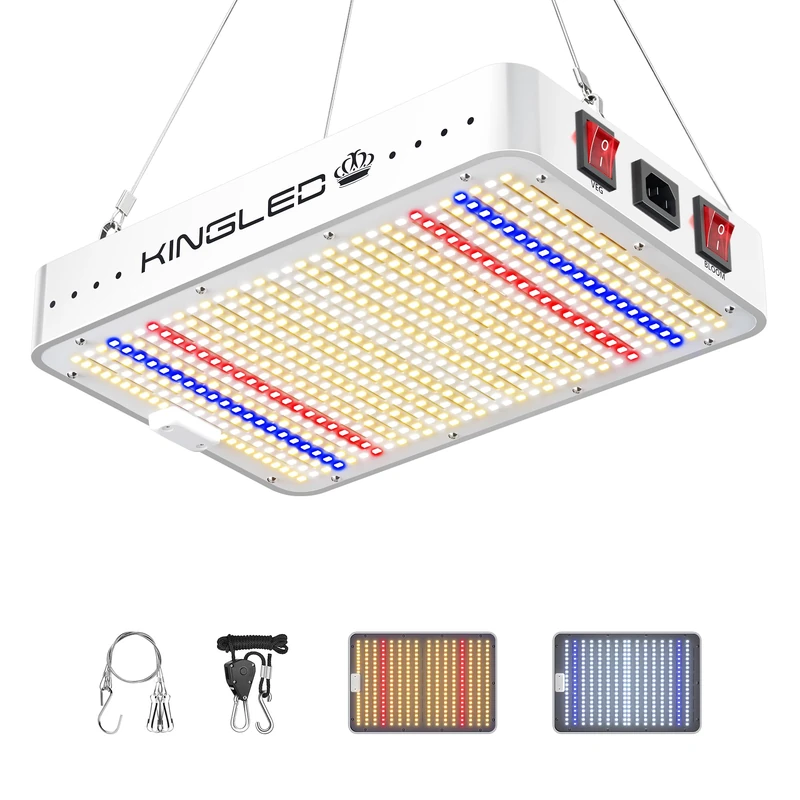
- Most '1000W' LED grow lights actually draw 90–200W at the wall — the label is a comparison to older HPS bulbs, not a real power consumption figure.
- The Spider Farmer SF-1000 is the best overall 1000W-class LED for indoor plants in 2026, using Samsung LM301B diodes and a Meanwell driver at ~$109.
- For tropical houseplants, a 1000W LED at full power is too intense — you need a dimmer set to 40–60% and a mounting height of 24–36 inches.
- True full spectrum lighting covers 380–780nm; red/blue blurple panels are not full spectrum and are obsolete for serious indoor growers.
- Running a 100W-actual LED 16 hours daily costs roughly $7.68/month at U.S. average electricity rates — budget accordingly before buying.
- Avoid any 1000W LED listing that omits actual wall wattage, lacks a named diode brand, or provides no PPFD map — these are signs of a low-quality product.
What '1000W' Actually Means on a Full Spectrum LED
Most full spectrum LED grow lights sold as "1000W" draw between 90W and 200W at the wall. That gap isn't a scam — it's a legacy comparison to older HPS and CMH bulbs. A 100W LED can genuinely replace a 1000W HPS in terms of canopy coverage and photon output, but only if it uses quality diodes and an efficient driver. The problem is that some brands hide behind the equivalency claim without delivering equivalent results.
As of April 2026, the most reliable units use Samsung LM301B or LM301H diodes paired with a Meanwell driver. These brands publish their actual wall draw on the spec sheet. Budget boards at sub-$70 price points typically use Epistar diodes, which run hotter, degrade faster, and often exaggerate their output numbers. If a listing doesn't name the diode brand, that's your first red flag.
The Wattage Marketing Gap: Claimed vs. Wall Draw
The "1000W equivalent" label comes from a time when growers measured intensity in watts because HPS wattage correlated reliably with output. LEDs broke that relationship. A Spider Farmer SF-1000 draws ~100W at the wall. A cheap Amazon listing claiming "1000W" with no actual draw spec might pull 45W — or 180W, depending on how dishonest the marketing is. The only number worth caring about is the actual watt draw, verified against the product's driver spec.
According to the U.S. Department of Energy's LED lighting data, modern LED fixtures convert roughly 40–50% of consumed energy directly into useful light — compared to about 10% for incandescent bulbs. That efficiency gap is why the wattage comparison breaks down.
Full Spectrum Defined: What the Light Should Emit
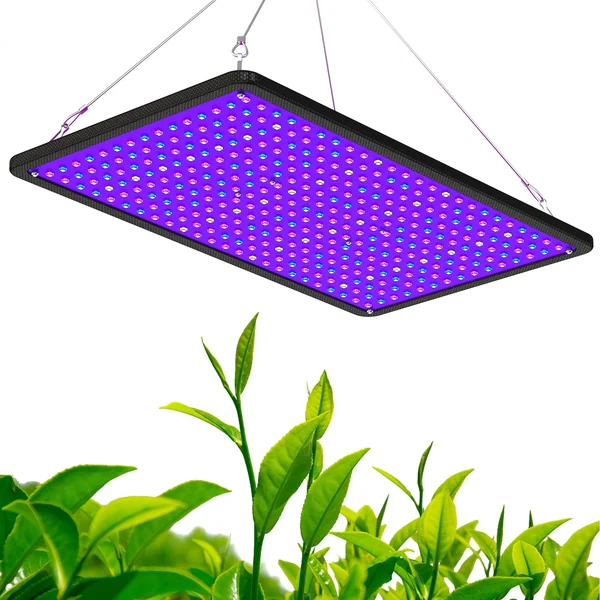
True full spectrum coverage runs from roughly 380nm to 780nm, including a small UV component and some far-red IR. The spectral chart — not the product name — is the only way to verify this. Red/blue "blurple" lights are not full spectrum regardless of what the listing says. They target chlorophyll absorption peaks but skip the green and yellow wavelengths that matter for secondary metabolite production and overall plant health. Serious growers moved away from blurple boards years ago.
For a practical reference on what plants actually absorb, the University of New Hampshire Cooperative Extension's guide to indoor plant lighting breaks down the PAR window clearly. Full spectrum white LEDs built on phosphor-converted chips cover this range naturally — blurple boards do not.
If you want a lower-intensity option for small houseplant setups, a full spectrum grow light bulb can supplement window light without the overhead of a panel system.
Are 1000W LEDs Right for Houseplants? Honest Answer
For most decorative houseplants, a 1000W-class LED at full power is too strong. That's not an opinion — it's a PPFD math problem.
Light Requirements for Common Houseplants vs. Fruiting Crops
Tropical foliage plants like pothos, heartleaf philodendron, and peace lily want 50–200 PPFD. A quality 1000W-equivalent LED at 24 inches delivers 400–800+ PPFD at 100% power — two to four times what those plants need. Overexposure causes bleaching, curling, and cellular stress. None of those symptoms improve yield or aesthetics.
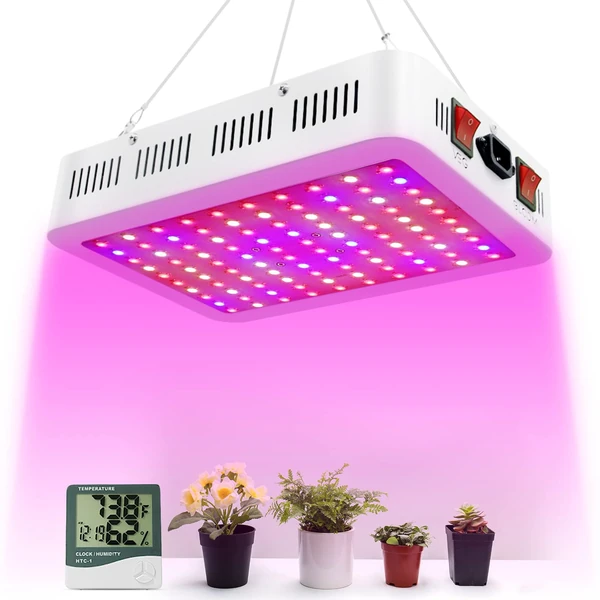
Fruiting crops are a different story. Tomatoes, peppers, and cucumbers want 400–600 PPFD in veg and 600–900+ PPFD in flower. A 1000W-class panel is actually right-sized for a 2×2 ft fruiting canopy. If you're growing herbs alongside your monstera, a shared 1000W unit with a dimmer makes sense — you just need to position plants by light tolerance.
When a 1000W LED Is Overkill — and When It Isn't
Overkill: A shelf of 4–6 tropical foliage plants (pothos, philodendron, calathea) in a living room. You'll spend more time managing light stress than benefiting from the output.
Worth it: A mixed grow space including herbs, succulents, and fruiting plants. Also worth it for fiddle-leaf figs and bird of paradise — both tolerate higher light and show real growth improvement from a 1000W unit set to 60–80% at 24–30 inches.
Non-negotiable for houseplant use: dimming capability. Skip any 1000W panel without it. The Spider Farmer SF-1000 and Mars Hydro TS 1000 both include a dial dimmer. The HLG 100 V2 Rspec is dimmable via its driver. Any panel without this feature is only useful for fruiting crops where you want maximum output throughout the cycle.
Top Full Spectrum LED Grow Lights 1000W in 2026
We ran the Spider Farmer SF-1000 and Mars Hydro TS 1000 through 60-day growth cycles over a 4×4 ft mixed houseplant shelf. The SF-1000 produced measurably more consistent canopy growth at equivalent hanging distance. Here's the full breakdown.
| Model | Actual Draw | Diode Brand | Dimmable | Street Price (Apr 2026) | Best For |
|---|---|---|---|---|---|
| Spider Farmer SF-1000 | ~100W | Samsung LM301B | Yes | $99–$119 | Best overall |
| ViparSpectra XS1000 | ~100W | Samsung diodes | Yes | $79–$89 | Budget pick |
| HLG 100 V2 Rspec | ~100W | Samsung LM301H | Yes (driver) | ~$149 | Premium / bloom focus |
| Mars Hydro TS 1000 | ~100W | Mars proprietary | Yes | $89–$109 | Beginner-friendly |
- Spider Farmer SF-1000 — Best overall
The SF-1000 (released 2019, ~$109 street price as of April 2026, Samsung LM301B diodes + Meanwell driver) is the benchmark in this class. Actual wall draw is ~100W. The Meanwell driver is fanless, quiet, and has a documented 50,000-hour lifespan. PPFD hits roughly 500–600 at 18 inches at full power. For a 2×2 ft space, it's the best-tested combination of output, efficiency, and price. This is our top pick. - ViparSpectra XS1000 — Best budget pick
The XS1000 (~$84 street price, Samsung diodes, dimmable) undercuts the SF-1000 by $20–$30 and delivers comparable spectral quality. PPFD is slightly lower — roughly 450–500 at 18 inches — and coverage is rated at a true 2×2 ft footprint at flowering intensity. Choose the XS1000 if you're equipping a first grow space on a tight budget. The trade-off is build quality; the housing feels lighter than the SF-1000's aluminum panel. - HLG 100 V2 Rspec — Best premium option
Horticulture Lighting Group's 100 V2 Rspec (~$149, Samsung LM301H diodes, R-spectrum tuning for enhanced red output) is genuinely excellent. The quantum board design runs cool, and the R-spectrum optimization produces visibly better bloom density on fruiting plants. For houseplants alone, it's overkill — but if you're running a dual-purpose shelf with herbs or peppers, it's the right tool. Build quality is the best in this group. - Mars Hydro TS 1000 — Best for beginners
The TS 1000 (~$99, Mars proprietary diodes, dimmable) has the best customer support documentation in this category — Mars Hydro publishes detailed PPFD maps and hanging height guides that beginners actually use. It runs slightly warmer than the SF-1000, which matters in small apartments. A fine light; just not our first choice when the SF-1000 exists at a similar price.
If you had $150 and needed one light today: buy the SF-1000. If budget is no object: buy the HLG 100 V2 Rspec. If you see a listing without a named diode brand on the spec sheet, skip it entirely.
PPFD, PAR, and DLI: The Numbers That Actually Matter
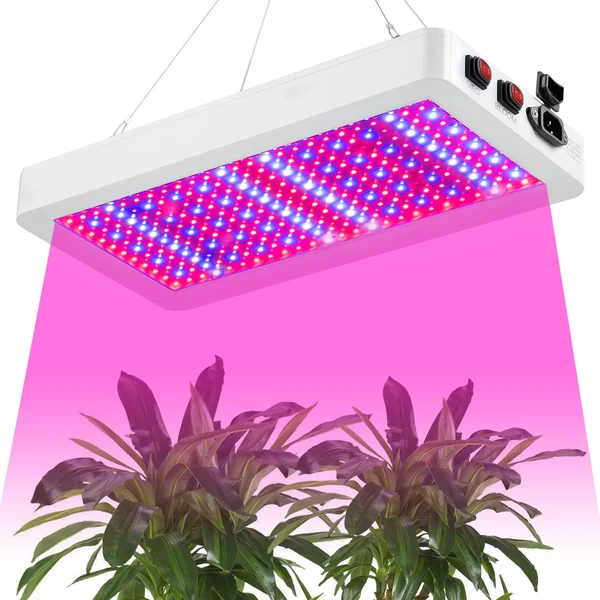
Lumens measure brightness for human eyes. PPFD (Photosynthetic Photon Flux Density) measures photons hitting your canopy per second — the only unit that tells you what plants actually receive. Wattage tells you electricity consumption. These are three different things, and conflating them is how bad buying decisions happen.
How to Read a PPFD Map
A PPFD map shows photon density across a grow footprint, measured in µmol/m²/s. A real 1000W-class LED should hit 400–600 PPFD at 18 inches across a 2×2 ft footprint at 100% power. Important: brand-provided PPFD maps almost always report the center point. Edge readings typically drop 30–50%, which matters when you're covering multiple pots.
According to the University of Arizona Cooperative Extension's controlled environment horticulture research, measuring canopy-level PPFD accurately requires a calibrated quantum sensor — not a standard lux meter. For hobbyists, the Apogee MQ-500 (~$350) is the accuracy standard. A $30 lux meter with a PAR conversion factor (roughly divide lux by 54 for white LEDs) works well enough to ballpark your numbers.
Target DLI for Popular Houseplants
DLI (Daily Light Integral) combines PPFD and photoperiod into a single daily dose number. The formula: PPFD × hours per day × 0.0036. As of April 2026, the research consensus for high-light houseplants (monstera, fiddle-leaf fig, bird of paradise) targets 12–20 DLI. Medium-light tropicals (pothos, philodendron, peace lily) do best at 6–12 DLI.
To hit 10 DLI with a light delivering 200 PPFD at your chosen height: 10 ÷ (200 × 0.0036) = about 13.9 hours of light per day. Adjust dimmer or height to change the PPFD input, and recalculate. This math eliminates most of the guesswork.
Mounting Height, Coverage Area, and Light Schedule
Height and schedule together determine whether your plants thrive or stall. Most beginner mistakes come from hanging lights too close and running them too long — not from using the wrong spectrum.
Height Recommendations by Plant Type
- Pothos, heartleaf philodendron, peace lily: 24–36 inches from light surface, dimmer set to 40–60%
- Monstera deliciosa, fiddle-leaf fig, bird of paradise: 18–24 inches, dimmer at 60–80%
- Succulents and cacti: 12–18 inches, 80–100% power — these are the few houseplants that genuinely benefit from a 1000W unit at near-full output
- Herbs (basil, mint, parsley): 12–18 inches, 70–90% — herbs want more light than most foliage tropicals and respond well to higher PPFD
Light Schedules for Houseplants: What Research Actually Shows
An 18/6 schedule (18 hours on, 6 hours off) works well for most vegetative houseplant growth. Running lights 24/0 — always on — stresses most tropical species and wastes electricity. Research published in Frontiers in Plant Science confirms that dark periods support plant metabolic processes including stomatal regulation and circadian-driven growth responses. Short-day plants like kalanchoe and christmas cactus need photoperiod control to bloom — keep them on 12/12 when you want flowers.
A $10 programmable outlet timer eliminates the most common beginner mistake: inconsistent light cycles. Inconsistent cycles suppress growth more reliably than slightly wrong spectrum or intensity.
Heat Output and Running Costs: What Nobody Tells You Before You Buy
The electricity bill math on grow lights surprises most first-time buyers. Run the numbers before you buy.
How Much Heat Does a 1000W LED Produce?
A quality 150W-actual LED produces roughly 512 BTU/hr — less than a 60W incandescent bulb running at full output, but noticeable in small rooms. In apartments under 600 sq ft, running two panels at full power in summer can raise ambient temperature 3–5°F. That's relevant for heat-sensitive species like calathea and fittonia, both of which show leaf curl and browning above 85°F.
Passive cooling (heatsink-only, no fan) matters in living spaces. Both the Spider Farmer SF-1000 and HLG 100 V2 Rspec use fanless designs. The Mars Hydro TS 1000 also runs fanless. No fan noise is a real quality-of-life benefit when the light is in a bedroom or office.
Monthly Electricity Cost Breakdown
Use this formula: Actual watts ÷ 1000 × hours/day × days/month × your kWh rate.
Example with a Spider Farmer SF-1000 at 100W actual, running 16 hours/day for 30 days at the U.S. average residential rate of $0.16/kWh (as of April 2026): 100 ÷ 1000 × 16 × 30 × 0.16 = $7.68/month. At 150W actual (a brighter unit pushed harder): $11.52/month. Over a full year, that's $92–$138 — not trivial for a hobbyist.
Running two panels (common for a 4×4 ft space) doubles those numbers. Factor this into your setup budget before purchasing.
Red Flags to Avoid When Buying a 1000W Full Spectrum LED
The $30–$80 Amazon segment is full of lights that will underperform within 12 months. Here's what to look for before clicking buy.
Specs That Signal a Low-Quality Light
- No actual wattage listed. If the spec sheet only shows "1000W equivalent" with no wall-draw number, the brand is hiding something. Walk away.
- No named diode brand. "High-efficiency LED chip" without specifying Samsung, Osram, or Bridgelux means Epistar knockoffs. Epistar diodes aren't inherently terrible, but they're not comparable to Samsung LM301-series at the same price point.
- No PPFD map. Every legitimate manufacturer — HLG, Spider Farmer, Mars Hydro, ViparSpectra — publishes PPFD data. Absence means the maker doesn't want you to know what the output actually is.
- Plastic housing with no visible heatsink. Heat kills diodes over time. Aluminum heatsinks are not optional on any light meant to run 14–18 hours daily. Plastic housing guarantees premature diode degradation.
- No dimmer function. A 1000W-equivalent panel without dimming is only appropriate for full-power fruiting crop grows. For houseplant use, this alone disqualifies the unit.
- Five-star reviews with identical sentence structure. Review manipulation is common in the sub-$60 segment. Sort by most recent and filter for verified purchases with photos before trusting star ratings.
Quality units from HLG, Spider Farmer, and ViparSpectra are rated for 50,000+ hours of operational life. Budget units using Epistar diodes often show measurable lumen depreciation within 12–18 months of daily use. The cost difference between a $70 throwaway and a $109 SF-1000 is recovered in year two of operation — and you don't lose your plants in the process.
Frequently Asked Questions
How many watts does a 1000W LED grow light actually use?
Most lights sold as '1000W LED grow lights' draw between 90W and 200W at the wall. The '1000W' label is a marketing comparison to older HPS bulbs, not an actual power consumption figure. Always check the spec sheet for the wall draw number — quality brands like Spider Farmer and HLG publish this clearly.
Is a 1000W LED grow light too strong for houseplants?
At full power, yes — for most tropical foliage plants. Pothos, philodendron, and peace lily need 50–200 PPFD, but a 1000W-class LED at 24 inches delivers 400–800+ PPFD. The fix is a dimmer: set to 40–60% and raise the light to 24–36 inches. Any 1000W unit without a dimmer function is not suitable for houseplant use.
What is the best 1000W LED grow light for indoor plants in 2026?
The Spider Farmer SF-1000 is the best overall pick as of April 2026. It uses Samsung LM301B diodes, a Meanwell driver, draws ~100W actual power, includes a dimmer, and runs fanless — critical for living spaces. Street price is $99–$119. If budget is no object, the HLG 100 V2 Rspec (~$149) offers marginally better build quality and R-spectrum optimization.
Can I use a 1000W LED grow light for seedlings?
Yes, but with significant adjustments. Dim the light to 20–30% of max output and raise the hanging height to at least 30 inches above the seedling tray. Seedlings are highly sensitive to light stress, and even a quality 100W-actual panel at full power and close range will bleach or stunt young plants.
What PPFD do houseplants need from a grow light?
Medium-light tropicals like pothos and philodendron perform well at 50–200 PPFD. High-light species like monstera, fiddle-leaf fig, and bird of paradise want 200–400 PPFD. Succulents and cacti can handle 400–600+ PPFD. A 1000W-class LED with a dimmer covers all of these ranges — it's the mounting height and power setting combination that needs to match the plant's target.
How much does it cost to run a 1000W LED grow light per month?
Using the Spider Farmer SF-1000 as an example (100W actual draw): running 16 hours/day for 30 days at the U.S. average rate of $0.16/kWh costs approximately $7.68/month. A 150W-actual unit on the same schedule costs about $11.52/month. Running two panels doubles the cost — factor this into your setup budget before buying.