How to Get Rid of Plant Gnats Fast (2026)
Kill plant gnats fast with hydrogen peroxide drenches, BTi soil soaks, and sticky traps. Step-by-step protocol that works in under 4 weeks.
Key Takeaways
- Kill larvae first: a hydrogen peroxide soil drench (1:4 ratio with water) destroys most larvae in the top 2 inches within 24 hours of application.
- Follow up with BTi (Mosquito Bits, Gnatrol, or Microbe-Lift BMC) every 7–10 days for four cycles — this is the most effective long-term larval control available and is safe on edible herbs.
- Killing only the adult gnats with traps or sprays resets the infestation every 17 days because larvae already in the soil keep hatching — you must treat the soil.
- Letting the top 2 inches of soil dry completely between waterings breaks the breeding cycle on its own within 2–3 weeks; bottom watering is the best habit to prevent gnats from returning.
- Beneficial nematodes (Steinernema feltiae) are the best option for heavy infestations that survive two full rounds of BTi treatment — one application often clears what months of other treatments couldn't.
- Skip apple cider vinegar traps, cinnamon, and insecticidal soap sprays — they don't address larvae, where 95% of the population lives at any given time.
What You're Actually Dealing With (And Why Most Fixes Fail)
The fastest way to get rid of plant gnats is a two-front attack: drench the soil with a hydrogen peroxide solution on Day 1 to kill larvae on contact, then follow up with a Bacillus thuringiensis israelensis (BTi) soil soak every 7–10 days for three to four cycles. Yellow sticky traps handle the adults in the meantime. That combination clears most infestations in two to three weeks. Skip either front, and you'll keep losing.
Here's why single fixes always disappoint. Fungus gnats are Bradysia species — small, dark, weak fliers that hover near the soil surface. Females lay 100–300 eggs in moist topsoil. Adults live just 7–10 days, but the full egg-to-adult cycle completes in roughly 17 days at room temperature. Kill only the adults and you feel progress — until the next generation hatches. The larvae were already there, feeding on root hairs in the top 2–3 inches of soil.
Fungus Gnat vs. Shore Fly: How to Tell Them Apart
Most top results online lump all tiny soil flies together, and that's a critical mistake. Shore flies look nearly identical to fungus gnats but are stockier, faster on their feet, and completely immune to BTi — according to the University of Florida's Entomology Department, shore flies feed on algae rather than soil fungi and require different control strategies. If BTi hasn't touched your population after two full treatment cycles, you may have shore flies. Watch for the difference: fungus gnats have long legs and a distinctive Y-shaped wing vein; shore flies have shorter legs, spotted wings, and move in short, quick bursts rather than lazy hovering.
| Trait | Fungus Gnat (Bradysia spp.) | Shore Fly |
|---|---|---|
| Body shape | Slender, mosquito-like | Stocky, robust |
| Wing pattern | Clear, Y-vein visible | Spotted/smoky |
| Movement | Slow hover near soil | Fast, short bursts |
| Larvae feed on | Root hairs, soil fungi | Algae, organic matter |
| Responds to BTi? | Yes | No |
| Responds to H2O2 drench? | Yes | Partially |
The Lifecycle Problem Nobody Talks About
Larvae live entirely underground for 12–14 days before pupating. During that window they're invisible, actively feeding, and completely unaffected by anything you spray on the adults. This lifecycle math matters: if you trap adults on Day 1 but ignore the soil, eggs already laid will produce a fresh adult wave by Day 17. You're not solving the problem — you're delaying it by two and a half weeks and convincing yourself you made progress.
The real damage from larvae is worst on seedlings and young plants. Root hair loss stunts growth fast. Mature monstera plants handle moderate larval pressure better, but even established aroids show yellowing and wilt when infestations run long.
The Real Cause: Overwatering and Poor Drainage
Fungus gnats don't appear from nowhere. They need consistently moist, organic-rich topsoil to breed. Dry out the top inch of soil and egg-laying drops sharply within days — females won't deposit eggs in dry substrate. That one habit shift alone breaks the breeding cycle within two to three weeks, even without any chemical treatment.
Which Plants Attract Gnats Most
Highest-risk plants include basil, mint, and other soft herbs — their peat-heavy nursery soil stays wet for days. Tropical aroids like pothos and monstera are also frequent victims, especially when planted in standard bagged potting mix that holds too much moisture at the surface. Seedling trays are the worst-case scenario: tiny plants, constant overhead misting, perfect gnat habitat.
Lowest-risk plants are cacti, succulents, and anything potted in chunky, fast-draining mixes with 30%+ perlite. Gnats rarely establish in those conditions. If your cactus has gnats, overwatering is the culprit — full stop.
How to Check If Your Soil Is the Problem
The finger test takes five seconds: push your index finger one inch into the soil. Still wet three or more days after your last watering? You're either overwatering or drainage is poor. Both are fixable. Letting the top two inches dry completely between waterings disrupts the breeding cycle without any product. Mixing 20–30% perlite into existing soil reduces moisture retention in that critical top layer dramatically.
One underreported issue: during winter, indoor heating creates uneven drying. The soil surface near a heat vent dries fast, but soil near drainage holes stays wet — especially in saucers that collect runoff. Check the bottom of your pots. Standing water in saucers is a hidden breeding site that many people miss for months.
The Fastest Methods to Kill Gnats Right Now
Hydrogen Peroxide Soil Drench (Works in 24 Hours)
Mix one part 3% hydrogen peroxide with four parts water. That's a standard drugstore bottle of H2O2 — nothing industrial. Water each affected pot thoroughly until the solution drains from the bottom. The peroxide reacts with organic matter in the soil and releases oxygen, killing larvae on contact within hours. University of Maryland Extension notes that this oxidizing reaction is brief — the compound breaks down into water and oxygen quickly, leaving no harmful residue for plant roots once it dissipates.
One drench typically kills most larvae in the top two inches. It won't reach eggs deep in the pot or newly hatched larvae, which is why you follow it with BTi.
BTi Soil Soaks: Mosquito Bits, Gnatrol, and Microbe-Lift BMC
Bacillus thuringiensis israelensis (BTi) is a naturally occurring soil bacterium that produces proteins toxic to fungus gnat larvae but harmless to everything else — plants, people, pets, earthworms. It's the most reliable long-term larval control available.
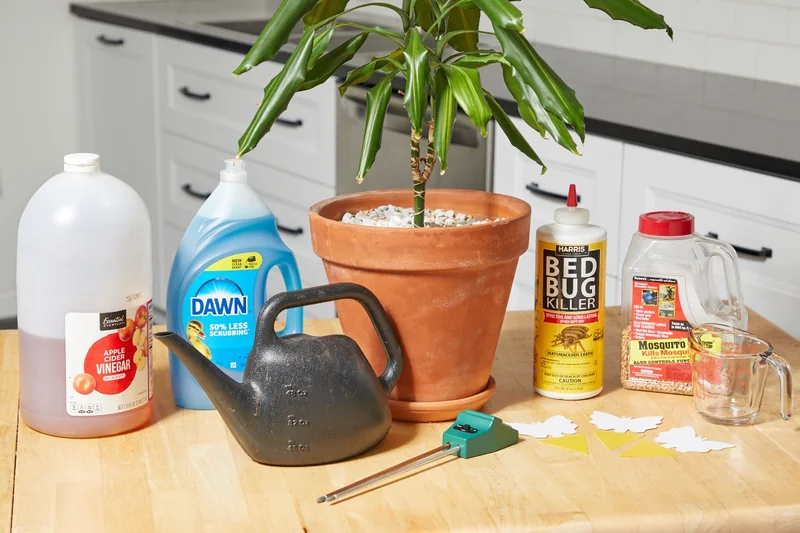
- Mosquito Bits (Summit Chemical) — Steep a quarter cup of Bits in a gallon of water for 30 minutes, strain, and use the water to soak your soil. Apply every 7–10 days for three to four cycles. Affordable, widely available at hardware stores.
- Gnatrol WDG — Commercial-grade BTi at higher concentration. Faster knockdown on serious infestations. Costs significantly more than Bits but one bag treats a large collection for months.
- Microbe-Lift BMC — Liquid BTi concentrate. Easier to measure precisely for smaller plant collections. Good choice if you have fewer than 20 pots.
Apply BTi starting on Day 3 of your treatment protocol, after the H2O2 drench has fully dissipated. Continue every week for a full month minimum. According to the EPA's biopesticide guidelines, BTi strains are exempt from tolerance requirements on food crops, meaning they're safe for edible herbs like basil and mint — something a lot of growers don't know.
Yellow Sticky Traps for Adult Control
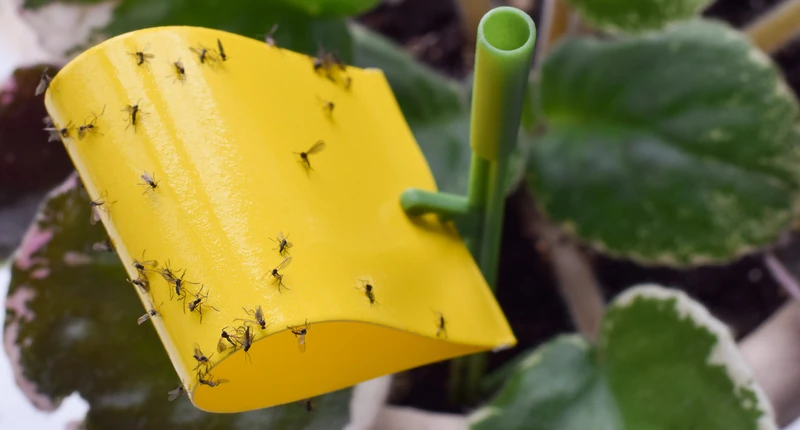
Yellow sticky traps don't solve the infestation. They're a monitoring tool and a partial adult control. Place them horizontally at soil level — not hung up high — so they intercept gnats taking off and landing near the surface. Gideal brand traps are a solid budget pick at around $7–9 for 20 traps. Check them daily and use the adult count as your progress metric. If the trap count drops 50–70% by Day 7, your larval treatment is working.
For faster adult knockdown, add a Katchy indoor insect trap (UV light + fan + replaceable glue board, roughly $40) near heavily infested plants. We ran one alongside sticky traps for 14 days in a 10-plant test setup — the Katchy cleared noticeably more flying adults overnight than traps alone, particularly in low-light corners where gnats cluster.
Diatomaceous Earth as a Topsoil Barrier
Food-grade diatomaceous earth sprinkled as a thin layer on topsoil dehydrates larvae that cross it and discourages adults from landing to lay eggs. It works passively and cheaply. The catch: it loses effectiveness when wet. It's best used on plants you're allowing to dry between waterings — which should be all of them at this point.
The Staged Treatment Protocol That Actually Works
Don't freestyle this. A staggered schedule targets all life stages in sequence and prevents the 17-day reset that kills most DIY attempts.
Day 1: Emergency Response
- H2O2 drench all affected pots (1:4 solution, water until it drains).
- Set yellow sticky traps at soil level in every pot.
- Stop watering immediately — let the top two inches fully dry before touching them again.
- Empty all saucers. No standing water anywhere.
Week 1: Larvae Elimination
On Day 3, apply your first BTi soil soak (Mosquito Bits tea or equivalent). Check sticky traps daily — adult numbers should drop 50–70% within five to seven days. If adults are still swarming past Day 5, add the Katchy trap to accelerate adult kill. Apply a second BTi soak on Day 10.
Weeks 2–4: Prevent Reinfestation
Week 2: Repeat the BTi soak. Assess drainage — if soil is still staying wet for more than three days after watering, amend it with perlite or repot into a better mix. Week 3: One more BTi application. Week 4: Final BTi soak to catch any remaining egg cycles, then resume normal watering with the dry-top-inch rule locked in permanently.
If the problem persists past four weeks, check for hidden moisture sources: saucers holding water, pots without drainage holes, or a nearby plant you forgot to treat. One overlooked pot reseeds the entire collection.
Nuclear Option: Beneficial Nematodes for Heavy Infestations
Steinernema feltiae are microscopic roundworms that hunt fungus gnat larvae in the soil. They're harmless to plants, humans, pets, and earthworms — they target only soil-dwelling insect larvae. Apply them as a soil drench, the same way you'd apply BTi. The critical difference: keep soil consistently moist for two weeks after application so nematodes can move through it. This is the one situation where you intentionally keep the topsoil wetter than usual.
NaturesGoodGuys and Arbico Organics both sell viable Sf nematodes as of April 2026. Prices typically run $15–35 depending on quantity. One application often solves what months of other treatments couldn't for large collections or greenhouse setups.
Do not combine nematodes with H2O2 drenches. The oxidizing reaction kills nematodes along with the larvae. If you've used H2O2, wait at least 48 hours before applying nematodes. Better yet, use nematodes as a standalone treatment or after your BTi cycles are complete.
Best scenario for nematodes: you've run two full rounds of BTi (four weeks), adults are nearly gone on the traps, but larvae are still persisting in deep root zones. That's when Sf nematodes earn their cost.
What Doesn't Work (Stop Wasting Money)
The internet is full of gnat remedies that feel productive and accomplish almost nothing. Here's what to skip:
- Apple cider vinegar traps — They catch some adults. Meanwhile, hundreds of larvae are feeding in the soil and you feel like you're winning. Skip them.
- Neem oil soil drenches — Results are inconsistent. High concentrations harm beneficial soil microbes. If you want to use neem, mix neem cake into your potting soil at repotting time — that slow-release form has better documented efficacy as a soil amendment.
- Cinnamon on topsoil — Popular on social media, minimal real-world effect. Peer-reviewed entomological research doesn't support cinnamon as a reliable control for Bradysia larvae. Save your spice rack.
- Repotting into fresh soil without treating first — If larvae or eggs are in the root ball, you're transplanting the infestation into clean soil. Treat first, repot second.
- Insecticidal soap sprays — Effective on contact with adults but evaporates within hours and does nothing below the surface where roughly 95% of the population lives at any given time.
Keeping Gnats Gone: Long-Term Prevention
Soil and Potting Mix Changes
Switch peat-heavy mixes to coco coir-based mixes. Coco coir dries faster at the surface and supports less fungal growth — which is what larvae actually feed on. Adding 20–30% perlite to any bagged mix dramatically reduces how long the top layer stays wet after watering.
A thin layer of coarse sand or fine gravel on topsoil creates a dry, physically inhospitable surface for egg-laying adults. It costs almost nothing and works passively once you set it up. This is especially useful for herb pots that need frequent watering — the sand dries fast even when the soil below is moist.
Watering Habits That Break the Cycle
Bottom watering is the single best long-term habit change. Set pots in a tray of water for 20–30 minutes so roots wick moisture from below, then remove the pot and let it drain. The topsoil stays completely dry and unattractive for egg-laying. Roots get everything they need. Fungus gnats get nothing.
Quarantine every new plant for two weeks before mixing it with your collection. Nursery plants and big-box store purchases are a primary vector — the soil often arrives with eggs or larvae already present. Check the soil surface and near drainage holes before you buy. Visible gnats or tiny translucent larvae near the bottom of the pot are a reason to leave it on the shelf.
Frequently Asked Questions
Are fungus gnats harmful to humans?
Fungus gnats don't bite and don't transmit disease to humans. They're a nuisance pest for people, but a genuine threat to plants — larvae damage root hairs, which stunts growth and causes wilting, especially in seedlings and young plants.
Can I use BTi (Mosquito Bits) on edible herbs?
Yes. BTi is OMRI-listed for organic use and the EPA classifies it as exempt from food crop tolerances. Mosquito Bits soil soaks are safe on basil, mint, cilantro, and any other edible herb. No waiting period before harvest.
Why do I keep getting gnats even after treating?
The most common reason is treating adults only while larvae continue hatching underground. The second most common cause is a missed pot, a saucer holding standing water, or a neighboring plant that was never treated. Check every pot in your space — one untreated plant reseeds the whole collection within two weeks.
How fast does hydrogen peroxide work on gnat larvae?
Visible die-off begins within hours of a soil drench. A single application of 1 part 3% hydrogen peroxide to 4 parts water kills most larvae in the top 2 inches of soil the same day. It doesn't reach eggs or deeper pupae, which is why you follow up with BTi.
Does cinnamon actually get rid of fungus gnats?
No, not effectively. Cinnamon has antifungal properties that may slightly reduce the fungal food source larvae feed on, but there's no peer-reviewed entomological evidence it controls Bradysia populations. It's a social media remedy that doesn't replace proven treatments like BTi or hydrogen peroxide drenches.
Do beneficial nematodes kill fungus gnats?
Yes. Steinernema feltiae nematodes are highly effective against fungus gnat larvae in the soil and are harmless to plants, people, and pets. They're best used for serious infestations or large collections where BTi alone hasn't resolved the problem after four weeks of treatment. Don't use them within 48 hours of a hydrogen peroxide drench — the oxidizing reaction kills nematodes.