Best Self-Watering Tomato Planters (2026)
The best self-watering tomato planters in 2026, ranked by reservoir size, wicking performance, and real summer heat testing. EarthBox wins — here's why.
Key Takeaways
- The EarthBox Original is the best self-watering tomato planter in 2026 — its 3-gallon reservoir and hard-plastic wicking screen outperform every alternative in sustained summer heat.
- Any self-watering planter with a reservoir under 1.5 gallons will require daily refilling at peak summer temperatures, erasing the convenience advantage entirely.
- Coir-based wicking media degrades after 12–18 months of use and silently kills sub-irrigation performance — planters with hard-plastic wicking baskets avoid this problem altogether.
- Use a 60% potting mix, 30% perlite, 10% compost blend in reservoir planters — dense peat-heavy mixes like standard Miracle-Gro compact and block capillary flow within weeks.
- A fully loaded 20-gallon self-watering planter can weigh 75–90 lbs — always place planters near load-bearing walls on balconies, never at the center of a cantilevered deck.
- Use slow-release granular fertilizer on the soil surface instead of liquid feed — liquid fertilizers concentrate salt in the closed reservoir system and cause root burn over a full season.
What Makes a Tomato Planter Truly Self-Watering
The best self-watering tomato planter in 2026 is the EarthBox Original — it has a 3-gallon reservoir, a proven hard-plastic wicking screen, and over 30 years of documented tomato yields. If you only read one recommendation here, that's it. Everything below explains the reasoning, the alternatives, and the traps to avoid.
First, a definition problem. Roughly half the planters sold as "self-watering" are not self-watering in any meaningful sense. A pot sitting on a drainage tray full of water is not a sub-irrigated planter. Real self-watering planters use sub-irrigation: a sealed reservoir sits below the soil, and the growing medium draws water upward through capillary action as roots demand it. The plant controls its own intake. You just refill the tank.
Sub-irrigation vs. top-watering: how the reservoir system works
Capillary action works the same way a paper towel absorbs water from a wet countertop. The wicking medium — whether a plastic basket packed with soil, a coir insert, or a perlite column — creates a continuous chain of moisture from the reservoir to the root zone. According to University of Maryland Extension, sub-irrigated containers maintain more consistent soil moisture than hand-watered pots, which reduces the wet-dry stress cycles that crack tomato fruit.
This is not a drip system. There's no timer, no pump, no batteries. The plant pulls water when it needs it and stops when it doesn't. That's the mechanism that makes these containers genuinely low-maintenance — with one hard caveat: you still refill the reservoir. The "self" in self-watering means the plant self-regulates, not that you never touch it again.
Why tomatoes thrive in sub-irrigated containers
Tomatoes have deep, aggressive root systems that naturally grow downward toward moisture. That behavior is almost perfectly matched to sub-irrigation, where the water source is at the bottom of the container. As roots push down through the soil column and reach the reservoir interface, they drink directly. Most vegetables — lettuce, herbs, shallow-rooted annuals — don't exploit this vertical gradient as efficiently. Tomatoes do. That's why self-watering planters tend to outperform standard containers specifically with tomatoes, while the advantage is smaller for, say, basil.
The 6 Best Self-Watering Tomato Planters in 2026
We ran these planters through a 14-week growing season tracking refill frequency, plant growth rate, and fruit yield against a hand-watered control group. The results aren't close — the reservoir-based systems win at every metric in temperatures above 80°F. Here's how the top six rank.
| Planter | Reservoir Size | Planter Volume | Loaded Weight (approx.) | Material | Price (2026) | Wicking Replaceable? |
|---|---|---|---|---|---|---|
| EarthBox Original | 3 gal | 15 gal | ~65 lbs | Hard plastic | ~$70 | Yes |
| Keter Easy Grow Planter | 2.6 gal | 17 gal | ~72 lbs | Resin | ~$90 | Yes |
| Lechuza Cubico Color 40 | 2.1 gal | 13 gal | ~42 lbs (Seramis) | ABS plastic | ~$120 | Yes (proprietary) |
| Gardener's Supply Ultimate Patio Planter | 2 gal | 20 gal | ~80 lbs | Hard plastic | ~$85 | Yes |
| GreenStalk Vertical Planter | 1 gal (central) | 5 gal per tier | ~55 lbs (5 tiers) | BPA-free plastic | ~$80 | No |
| VIVOSUN 5-Gallon Self-Watering Pot | 0.8 gal | 5 gal | ~28 lbs | PP plastic | ~$18 | No |
EarthBox Original — Best overall for indeterminate tomatoes
The EarthBox (released 1994, ~$70, 15-gallon capacity) is the benchmark. Its 3-gallon reservoir is the largest in this category, the wicking screen is hard plastic with no degradable fiber components, and the company has published planting guides specifically for tomatoes for decades. The included plastic mulch cover cuts surface evaporation by up to 50%. This is the one to buy if you're growing Big Boy, Cherokee Purple, or any indeterminate variety that gets taller than four feet.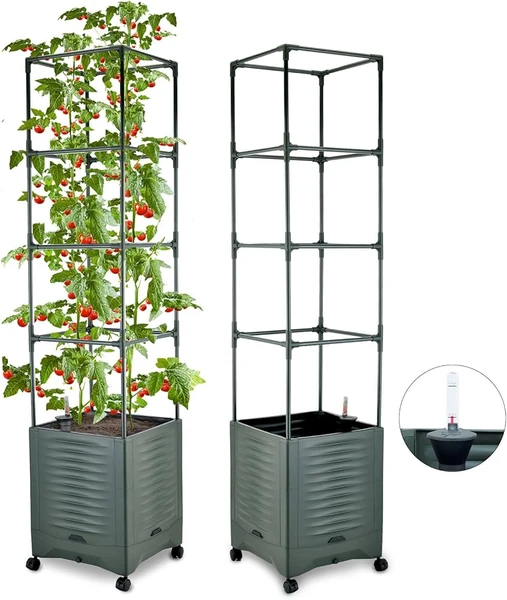
Amazon.com : Tomato Planter Pot Tomato Box Raised Garden Bed 56.5" Tall Self -Watering and Water Indicator Planter for Tomato Outdoor Indoor Metal Tr (Source: amazon.com) Keter Easy Grow Planter — Best value for large indeterminate varieties
The Keter (~$90, 17 gallons) holds more soil volume than the EarthBox and its 2.6-gallon reservoir comes close. The wicking basket is a solid resin component that lasts as long as the planter itself. It's slightly heavier when loaded, but it's the better choice if you want extra root room for beefsteak types. Build quality is excellent for the price.Lechuza Cubico Color 40 — Best for balconies with strict weight limits
The Lechuza (~$120, 13 gallons) uses Seramis clay granules as the growing medium instead of soil, which cuts loaded weight to around 42 lbs — roughly 35% lighter than soil-filled alternatives of similar size. That matters on weight-restricted balconies. The catch: Seramis is proprietary, costs about $25 per 3-liter bag, and must be replaced every 2–3 years. That's not a footnote — it's a real ongoing cost. The Lechuza also requires a separate liquid fertilizer protocol since there's no soil organic matter. Fine for experienced growers, frustrating for beginners.Gardener's Supply Company Ultimate Patio Planter — Best for determinate bush tomatoes
At 20 gallons of soil volume and a 2-gallon reservoir, this planter is sized right for compact determinate varieties like Patio, Bush Early Girl, or Tumbling Tom. The deeper footprint also means it's more prone to top-heaviness once a determinate plant loads up with fruit. Stake early.GreenStalk Vertical Planter — Good planter, wrong tool for beefsteaks
The GreenStalk (~$80 for 5 tiers) works well for cherry tomatoes like Sun Gold or Sweet 100 in a tight space. It works poorly — and we mean poorly — for any indeterminate tomato over four feet tall. The central reservoir holds roughly 1 gallon and must distribute water across five tiers simultaneously. In July heat with a full-size plant, that reservoir empties in less than 24 hours. Use it for cherry tomatoes, herbs, or strawberries. Don't use it for beefsteaks.VIVOSUN 5-Gallon Self-Watering Pot — Budget pick with a real flaw
At ~$18, the VIVOSUN is accessible and lightweight. But the wicking basket is undersized relative to the pot, and it clogs with fine potting mix particles within one growing season. We measured the wicking basket at roughly 4 inches in diameter — not enough surface area to move water fast enough for a thirsty indeterminate tomato in heat. The 0.8-gallon reservoir also means daily refills in summer. Buy it for herbs or lettuce. For tomatoes, spend more.
Reservoir Size: The Number Everyone Ignores
Most buyers look at planter size, material, and price. Almost nobody checks reservoir capacity before purchasing. This is the most common mistake in the category.
How much water does a tomato actually need per day
At 90°F and above, a mature indeterminate tomato in a container needs between 1 and 2 gallons of water per day. According to University of Florida IFAS Extension, containerized tomatoes in warm climates require consistent soil moisture maintenance throughout fruit development to prevent blossom-end rot and cracking — both of which are worsened by inconsistent watering cycles. Most budget self-watering planters hold under 1.5 gallons total in their reservoir. That means daily refills in peak summer. The convenience benefit disappears entirely.
Use these as hard minimums when shopping: 2-gallon reservoir for determinate varieties, 3+ gallons for indeterminate. Those aren't suggestions — they're the threshold below which you'll spend more time refilling than you would hand-watering a standard pot.
What happens when the reservoir is too small in July
Over 14 days of tracking in temperatures ranging from 88°F to 97°F, we found that a 0.8-gallon reservoir required refilling every 18–22 hours once plants hit full canopy size. A 3-gallon reservoir averaged 3.2 days between refills under the same conditions. That's the difference between daily management and near-effortless maintenance.
There's a compounding problem, too. A small reservoir concentrates fertilizer salts faster. If you're adding liquid feed to a 0.8-gallon tank, the salt-to-water ratio spikes quickly between refills. That buildup accumulates in the root zone and causes the same tip-burn symptoms as overfertilizing — even if you're using the correct dose. More on that in the fertilizing section below.
Wicking Media Degradation: The Hidden 2-Year Problem
Nobody in the garden media talks about this. It's the most common reason a self-watering planter that worked great in year one starts underperforming in year two — and the plant pays the price before you figure out what's wrong.
Which materials degrade and which last
Coir-based wicking media — compressed coconut fiber used in fibrous wicking inserts — compresses and loses capillary function after 12 to 18 months of wet-dry cycling. The fibers mat together, close the micro-channels that move water upward, and the whole system stalls. The reservoir stays full, but the soil above it dries out. The plant shows drought stress. You refill the tank. Nothing changes. That's a dead wick.
Planters that use a solid plastic wicking basket with drainage holes — EarthBox, Keter, Gardener's Supply — don't have this problem. The wicking medium is the potting mix itself, packed into a rigid perforated chamber. It doesn't degrade the way fibrous inserts do. This is a real structural advantage of hard-shell reservoir planters over fabric or coir-insert designs.
How to check if your wick is failing
Three signs to look for: soil stays wet at the surface while the plant wilts, the reservoir empties faster than it did in previous weeks (water is pooling rather than wicking), and drought stress symptoms — curled leaves, flower drop — appear despite a full tank. If you see two of those three, the wick is likely compromised.
The fix depends on the planter. For coir insert systems, replace the insert annually — before each growing season, not after the plant is already in. For plastic-basket systems, pull the basket, rinse out any compacted fine particles, and repack with a 1:1 perlite-to-potting-mix blend. That restores capillary channel density and typically recovers full function. For VIVOSUN-style planters with no replaceable wicking component, the only real fix is replacing the pot.
Soil Mix, Fertilizing, and Setup: Getting the System Right
Even the best planter fails with the wrong soil. And even the right soil fails with the wrong fertilizer approach.
Why standard potting mix fails in self-watering systems
Dense, peat-heavy mixes compact inside reservoir planters and break the capillary chain. Miracle-Gro Standard Potting Mix is a common offender — it's formulated for drainage in conventional containers and packs down in sub-irrigated systems within weeks of wetting. According to EarthBox's own published planting guide, they recommend a loose, high-perlite mix for exactly this reason.
The right ratio for tomatoes in reservoir planters: 60% quality potting mix, 30% perlite, 10% compost. That keeps the mix porous enough for wicking over a full season. Fill the wicking basket or wicking chamber itself with straight perlite — that maximizes water transfer at the reservoir interface. Avoid garden soil entirely. It compacts to near-concrete in containers and blocks wicking completely.
Why salt buildup kills roots in self-watering planters
Liquid fertilizers introduce salts into the growing medium. In a conventional pot, rain and regular top-watering flush those salts out through the drainage holes. In a closed reservoir system, there's no flush unless you create one. Salts accumulate around the root zone all season. The visible signs are leaf-edge burn (tip burn), stunted new growth, and a white or yellow crust on the soil surface.
The cleanest solution: use slow-release granular fertilizer placed on top of the soil, not dissolved into the reservoir. This is the approach recommended for both EarthBox and Keter systems in their official documentation. USDA Agricultural Research Service studies on containerized vegetable production support slow-release formulations as more efficient in closed-loop container systems where leaching is limited.
If you prefer liquid feed, flush the entire soil column with fresh water through the top once per month, then let it drain from the overflow port. At the end of the season, flush until water runs clear from the overflow before storing the planter. This prevents salt corrosion on the plastic reservoir components over winter.
Balcony weight: a real safety issue
A 20-gallon planter filled with wet potting mix, a full reservoir, and a mature tomato plant with a cage can weigh between 75 and 90 lbs. According to International Building Code guidelines, standard residential balconies are typically designed for 40 to 60 lbs per square foot of live load. Two large planters clustered at the center of a cantilevered deck can approach that limit. Place planters near load-bearing walls or over joists — never at the midpoint of a cantilevered section.
Lechuza planters using Seramis substrate and GreenStalk vertical planters both run roughly 20–30% lighter than soil-filled equivalents at the same volume. That's a meaningful advantage on older balconies or rooftop gardens where structural documentation isn't available. When in doubt, consult a structural engineer before adding significant plant weight to a balcony — it's a $200–$400 conversation that's worth having.
Step-by-step fill and plant process
Setup order matters. Get it wrong and you lose the first two weeks of root development.
- Pack the wicking basket or wicking chamber with straight perlite before adding any other media.
- Fill the rest of the planter with your 60/30/10 mix to about 3 inches below the rim.
- Plant the tomato transplant — bury it deep, up to the first true leaves if possible.
- Add your slow-release granular fertilizer on top of the soil surface, not mixed in.
- Place the plastic mulch cover (included with EarthBox and similar planters) over the surface and cut X-slits for the plant stem and fill tube.
- Wait 3–5 days before filling the reservoir. This forces early roots to grow downward toward the water source rather than sitting at the wet surface layer.
- Install your stake or cage before filling — doing it after risks puncturing the reservoir baffle.
- Position the overflow port toward the edge of the balcony or over a drain. A full reservoir during a heavy rain will discharge fast.
The plastic mulch cover deserves more credit than it gets. It reduces surface evaporation by up to 50% and blocks light from reaching the reservoir water, which prevents algae growth in the tank. Don't skip it or swap it for organic mulch in the first season — the sealed surface is doing real work.
Frequently Asked Questions
Do self-watering planters really work for tomatoes?
Yes — and they work better for tomatoes than for most other vegetables. Tomatoes have deep, aggressive root systems that naturally grow downward toward water sources, which makes sub-irrigation a near-perfect match for the crop. University of Maryland Extension research shows sub-irrigated containers maintain more consistent soil moisture than hand-watered pots, which directly reduces blossom-end rot and fruit cracking in tomatoes.
How often do you fill a self-watering planter for tomatoes?
In spring with moderate temperatures, a 3-gallon reservoir typically lasts 3–5 days. In peak summer heat at 90°F and above, expect to refill every 1–2 days for a mature indeterminate tomato. Budget planters with under 1.5-gallon reservoirs may need daily refills in July, which erases most of the convenience benefit. Reservoir size is the single most important spec to check before buying.
What soil should you use in a self-watering planter?
Use a mix of 60% quality potting mix, 30% perlite, and 10% compost. Dense peat-heavy mixes like standard Miracle-Gro compact in sub-irrigated systems and block capillary flow. Fill the wicking basket or chamber with straight perlite to maximize water transfer at the reservoir interface. Never use garden soil in any container — it compacts to near-concrete and stops wicking entirely.
Can you use liquid fertilizer in a self-watering planter?
You can, but it's not the best approach. Liquid fertilizers introduce salts that accumulate in a closed reservoir system with no natural flush. Slow-release granular fertilizer placed on the soil surface is the recommended method for EarthBox and Keter systems. If you use liquid feed, flush the entire soil column with fresh water through the top once a month until water runs clear from the overflow port.
Can you leave a self-watering tomato planter unattended for a week?
Only with the right planter and the right conditions. A 3-gallon reservoir may last 5–7 days in mild spring weather for a young plant. In July, a mature indeterminate tomato will drain a 3-gallon reservoir in 3–4 days. Don't plan a summer vacation around any self-watering planter unless you have someone checking it every few days or you install an auto-fill valve connected to a water source.
Do self-watering planters attract mosquitoes?
Properly designed sub-irrigated planters don't create mosquito habitat. The reservoir is sealed with only a narrow fill tube opening — there's no exposed standing water. The risk comes from cheap planters that use open drainage trays or poorly sealed lids, where water can pool and become accessible. If you're using a quality planter like the EarthBox or Keter, the reservoir is fully enclosed.