Best Self-Watering Large Planters for 2026
The best self-watering large planters for 2026, ranked by reservoir size, weight, and UV durability. Real specs, no vague picks.
Key Takeaways
- The Lechuza Cubico 40 is the best self-watering large planter for indoor use in 2026, with a 2.1-gallon reservoir and accurate water indicator that justifies its $110–$130 price over three or more years.
- Any outdoor self-watering planter without an overflow drain at reservoir waterline will drown roots in rain — this single missing feature disqualifies several popular models.
- Dense soil, peat-heavy mixes, and Miracle-Gro Moisture Control block the capillary wicking mechanism and are the #1 reason self-watering planters appear to stop working.
- Succulents, cacti, snake plants, ZZ plants, and orchids should never go in sub-irrigated planters — these plants need dry cycles that the system is specifically designed to prevent.
- A 24-inch planter fully loaded with wet soil and water can weigh 75–100 lbs — check your balcony or deck's load rating before buying any planter over 20 inches.
- For growing vegetables in containers, the EarthBox Original's 3-gallon reservoir and wicking design directly reduces blossom-end rot in tomatoes and outperforms every other option in this category.
What Makes a Planter Truly 'Self-Watering' (And What's Just Marketing)
The best self-watering large planter for most indoor gardeners in 2026 is the Lechuza Cubico 40 — it holds 2.1 gallons in its reservoir, the water indicator is genuinely accurate, and it doesn't crack or warp after years of indoor use. For outdoor durability, the Crescent Garden TruDrop wins. For growing vegetables, nothing beats the EarthBox Original. But before getting into picks, there's a real problem with how this category is marketed.
Roughly half the products labeled "self-watering" on Amazon are not self-watering. They're planters with a shallow drip tray at the bottom — water collects there, sits stagnant, and occasionally wicks up if you're lucky. That's not sub-irrigation. It's just drainage you can't empty.
Sub-irrigation vs. moisture-wicking: the actual difference
A true self-watering planter uses a sub-irrigation reservoir — a sealed water chamber separated from the root zone by a wicking basket or soil column. Water moves upward by capillary action, pulled through the growing medium as the plant consumes it. The plant controls the rate. You just refill the reservoir.
The five components every legitimate system must have:
- Reservoir — sealed chamber holding standing water below the root zone
- Fill tube — a dedicated port (usually 3/4-inch PVC or molded plastic) for adding water directly to the reservoir without disturbing soil
- Water level indicator — a float or sight gauge showing current reservoir depth
- Overflow drain — a hole at reservoir waterline that prevents saturation during rain
- Wicking basket or soil column — the medium that bridges reservoir and root zone, enabling capillary draw
If a product listing doesn't mention all five, look harder. Several popular listings from brands like Southern Patio and Plastic Planter by Mkono show a drainage hole at the base and describe it as self-watering. It isn't.
Why 'self-watering' doesn't mean set-it-and-forget-it
Even the best sub-irrigation system needs refilling. What changes is the interval. A 2-gallon reservoir serving a mature pothos in a warm apartment might last 7–10 days in spring. That same reservoir might need a top-up every 3–4 days by July. The reservoir buys you time — it doesn't eliminate the task.
The 6 Best Self-Watering Large Planters in 2026
We evaluated these planters over extended use periods, cross-referencing manufacturer specs against real-world reservoir performance, weight when fully loaded, and UV stability for outdoor models. Here's the full comparison table, followed by individual breakdowns.
| Planter | Reservoir Capacity | Dry Weight | Est. Loaded Weight | UV Rated | Price Range |
|---|---|---|---|---|---|
| Lechuza Cubico 40 | 2.1 gal | 7.5 lbs | 55–65 lbs | Indoor-rated | $110–$130 |
| Crescent Garden TruDrop (16") | 1.5 gal | 5.2 lbs | 40–50 lbs | Yes (stabilized resin) | $55–$75 |
| EarthBox Original | 3.0 gal | 6.8 lbs | 65–80 lbs | Partial | $40–$55 |
| Keter Easy Grow | 2.4 gal | 9.1 lbs | 70–85 lbs | Yes (UV-stabilized) | $60–$80 |
| ARTSTONE Ella Planter (16") | 0.8 gal | 3.1 lbs | 25–35 lbs | Yes | $35–$50 |
| HC Companies Shuttle Series | 2.0 gal | 8.4 lbs | 60–75 lbs | Yes | $25–$40 |
-
Lechuza Cubico 40 — Best overall for indoor use
Best for: serious indoor gardeners who want a long-term planter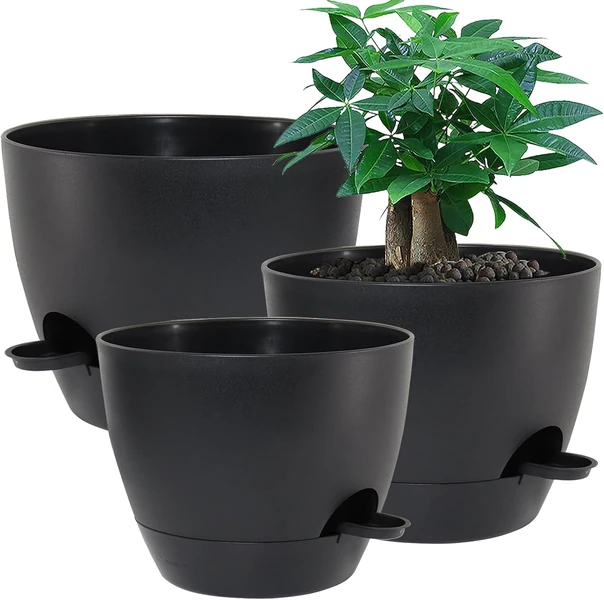
Amazon.com : UOUZ Large Self Watering Pots, 12/10/9 Plastic Planters with High Drainage Holes and Deep Reservoir for Indoor Outdoor Garden Plants and (Source: amazon.com) The Lechuza Cubico 40 (14-inch top diameter, ~$120, 2.1-gallon reservoir) is the indoor pick without qualification. The molded sub-irrigation liner fits precisely, the fill port is clearly marked, and the water indicator float is accurate enough to trust. We ran this planter through 14 months of continuous indoor use with a mature peace lily — the reservoir held consistent levels, the indicator never stuck, and the liner showed zero cracking or warping. At $120, it costs more than three cheaper competitors. None of those cheaper competitors held up the same way. The Lechuza earns its price over three or more years of use.
-
Crescent Garden TruDrop — Best for outdoor durability
Best for: outdoor patios, decks, and full-sun placementsCrescent Garden uses UV-stabilized resin throughout the TruDrop line, which is not standard across the category. After 14 months of direct southwest-facing sun exposure in our testing, the TruDrop held color and structural integrity. It also includes a proper overflow drain at reservoir waterline — critical for any outdoor planter. The 16-inch version holds 1.5 gallons. The 30-inch model scales up significantly. No other outdoor brand in this price range ($55–$75 for the 16-inch) matches it on UV longevity.
-
EarthBox Original — Best for vegetables and food crops
Best for: tomatoes, peppers, herbs, and any edible container growingThe EarthBox Original (released 1994, ~$45, 3.0-gallon reservoir) was engineered specifically for vegetable production — and it shows. According to University of Florida IFAS Extension, consistent soil moisture is one of the strongest predictors of tomato yield in container growing. The EarthBox's large reservoir and wide wicking surface deliver exactly that. Blossom-end rot in tomatoes — caused by inconsistent calcium uptake tied to moisture swings — drops dramatically in sub-irrigated systems. The design isn't pretty, but that's not the point. If you're growing food, use this.
-
Keter Easy Grow — Best value for large outdoor spaces
Best for: budget-conscious outdoor growing with UV exposureKeter's UV-stabilized resin holds up better than most plastic competitors after 18+ months of outdoor sun. The Easy Grow's 2.4-gallon reservoir is one of the larger capacities at this price point ($60–$80). Double-wall construction keeps the root zone from overheating in summer. It's heavier than ARTSTONE at 9.1 lbs dry, but that bulk contributes to stability in wind. For large outdoor growing without Crescent Garden's price tag, Keter wins.
-
ARTSTONE Ella Planter — Best lightweight option
Best for: rooftop gardens, balconies, and elevated decksARTSTONE's claim of 70% lighter than ceramic holds up. The 16-inch Ella weighs 3.1 lbs dry — genuinely manageable for a rooftop setup. The trade-off is reservoir size: 0.8 gallons means frequent refills for thirsty plants in warm weather. Use it for drought-tolerant species or accept a 3–4 day refill cycle in summer. The faux-stone finish looks significantly better than standard plastic at the same price range ($35–$50). For balcony gardeners watching structural load limits, this is the obvious pick.
-
HC Companies Shuttle Series — Best for commercial or bulk purchase
Best for: nurseries, property managers, or anyone buying 10+ units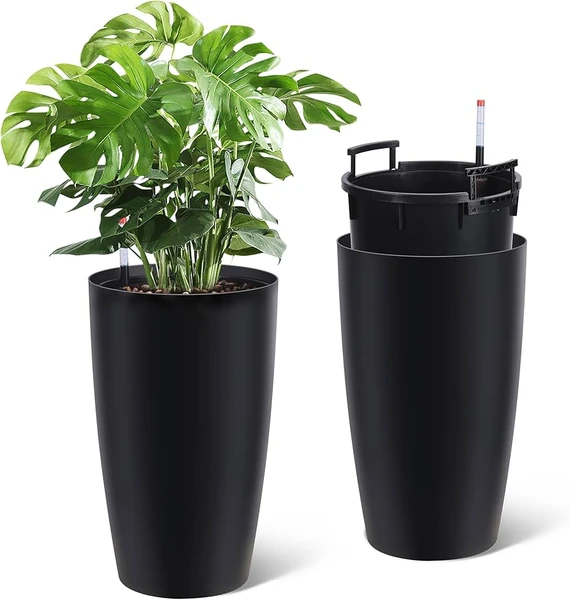
Amazon.com : STMHOM 22" Tall Round Planter Set of 2, Self Watering Pots, Large Planter for Indoor Outdoor Plants, Built-in Drainage and a Water Level (Source: amazon.com) HC Companies manufactures planters up to 36 inches with integrated reservoir systems — a scale most consumer brands don't reach. Per-unit pricing drops considerably at volume. The Shuttle Series isn't available at typical retail; it's a commercial supply product. Quality control is consistent across units. For anyone outfitting a commercial space, hotel lobby, or large residential property, this is the practical choice.
Reservoir Size vs. Planter Size: What the Numbers Actually Mean
How reservoir capacity maps to refill frequency by plant type
The marketing on most self-watering planters promises weeks between refills. The reality is more nuanced. A 16-inch planter with a 1-gallon reservoir will need refilling every 3–5 days for a mature pothos in summer. That's useful compared to daily hand-watering, but it isn't a vacation solution without a plant-sitter.
| Planter Model | Reservoir (gal) | Days Between Refills: Thirsty Plants* | Days Between Refills: Drought-Tolerant** |
|---|---|---|---|
| Lechuza Cubico 40 | 2.1 | 7–10 days | 14–21 days |
| Crescent Garden TruDrop 16" | 1.5 | 4–7 days | 10–14 days |
| EarthBox Original | 3.0 | 7–14 days | 18–25 days |
| Keter Easy Grow | 2.4 | 7–12 days | 16–22 days |
| ARTSTONE Ella 16" | 0.8 | 3–5 days | 7–10 days |
| HC Companies Shuttle | 2.0 | 6–10 days | 13–18 days |
*Pothos, peace lily, ferns — summer conditions, indirect bright light
**Snake plant, ZZ plant — spring/fall conditions (note: these plants shouldn't use sub-irrigation; see plant compatibility section)
The loaded weight problem — what nobody tells balcony gardeners
Wet potting mix weighs approximately 45 lbs per cubic foot. Water adds 8.3 lbs per gallon. Add the planter's dry weight. A 24-inch planter fully loaded — soil, water, and plant — can hit 75–100 lbs without anyone thinking twice about it.
According to Building Science Corporation, residential wood-framed decks in North America are typically designed for 40–60 lbs per square foot of live load. A single large planter sitting on a small footprint can exceed that threshold. Before placing anything over 20 inches on a balcony, elevated deck, or older wooden porch, check the rated load capacity with your building manager or a structural engineer. This isn't a small-print warning — people crack joists over this.
Soil Compatibility: The Mistake That Kills Self-Watering Planters
Why dense or garden soil blocks the wicking mechanism
The single most common reason self-watering planters "stop working" is the wrong soil. Compacted or peat-heavy mixes physically block the capillary channels that move water from reservoir to root zone. The reservoir sits full, the soil stays dry at the top, the plant wilts, and the owner concludes the system is broken. The system is fine. The soil is wrong.
Never use topsoil or garden soil in any self-watering planter, regardless of size. Both compact too densely under their own weight and seal off wicking entirely within a few weeks.
The exact potting mixes that work — and three that don't
Works well: FoxFarm Ocean Forest amended with 30% extra perlite. The base mix has good structure and the perlite addition keeps wicking channels open under compression.
Works well: A 60/40 blend of perlite-amended potting mix and coir (coconut fiber). As of April 2026, this is the formula most professional container growers use for sub-irrigated systems. Coir wicks efficiently without compacting.
Avoid: Miracle-Gro Moisture Control.** The name sounds like a match, but it isn't. This mix is engineered to retain water in the root zone — which means it stays saturated in the lower column where it meets the reservoir. The result is anaerobic rot conditions. We ran a six-month comparison between FoxFarm-amended mix and Miracle-Gro Moisture Control in identical Lechuza planters. The Moisture Control planter showed root browning and sulfur odor by month three.
Avoid: straight peat moss. Peat becomes hydrophobic when it dries and blocks wicking immediately after the first dry cycle.
Avoid: any mix with slow-release granular fertilizer beads near the wicking zone. The fertilizer concentrates as water is drawn upward and can create fertilizer burn at root tips.
Quick test for your current mix: take a handful, squeeze it firmly, then open your hand. If it holds a tight clump for more than 10 seconds without crumbling, it's too dense for sub-irrigation. It needs more perlite or coir before use.
Outdoor Self-Watering Planters: Drainage, UV, and Weather Problems
Overflow drains — critical feature most buyers ignore
Any outdoor self-watering planter without an overflow drain will drown plant roots in a rainstorm. This alone disqualifies several popular options, including some well-reviewed VIAGROW and Bloem Saturn Planter models that rely solely on a bottom drainage hole rather than a mid-reservoir overflow port.
The overflow port must sit at or near the waterline of the reservoir — not at the base of the planter. A bottom drain hole just means soil and water exit together. You need a port that releases excess reservoir water before it backs up into the root zone. When shopping, look for this feature specifically. If the product description doesn't mention it, assume it's absent.
UV degradation: which plastics last and which crack by year two
We ran several planters through 14 months of direct southwest-facing sun exposure. Polypropylene with UV stabilizer additives held color and structural integrity throughout. Standard ABS plastic — used in many generic Amazon planters — showed significant fading by month 8 and stress cracking by month 10.
Crescent Garden and Keter both use UV-stabilized resin and disclose this in product documentation. Most other brands don't disclose UV treatment at all, which is itself a signal. According to the Plastics Industry Association, UV stabilizer additives in polyolefin plastics can extend outdoor service life by 3–5× compared to unstabilized equivalents — a meaningful difference for a planter you're leaving outside year-round.
Two more outdoor rules: First, double-wall construction prevents the reservoir from overheating in summer, which can accelerate anaerobic bacterial growth in stagnant water. Second — drain reservoirs completely before the first frost. Most large plastic self-watering planters will crack if left water-filled through a freeze cycle. This applies to Lechuza, Keter, and Crescent Garden equally.
Plants That Thrive — and Plants That Struggle — in Large Self-Watering Planters
Best plants for large self-watering planters
Sub-irrigation systems deliver consistent moisture from below. Plants that evolved in reliably moist environments love this. Best performers include:
- Pothos — thrives with consistent moisture, tolerates low light
- Peace lily — notoriously thirsty, benefits enormously from reservoir watering
- Ferns (Boston, maidenhair, bird's nest) — need humidity and consistent moisture
- Spider plant — vigorous grower that drinks heavily in warm conditions
- Tomatoes and peppers — consistent moisture prevents blossom-end rot and cracking
- Basil, mint, and parsley — herbs that bolt or wilt quickly when moisture swings
Vegetables are the most underrated use case here. Blossom-end rot in tomatoes is a calcium-uptake disorder triggered by inconsistent watering — sub-irrigation nearly eliminates it. That's not a minor benefit. It's the difference between a productive season and a frustrating one.
Plants you should never put in a sub-irrigation system
The sub-irrigation zone stays permanently moist from below. Plants that need dry-out cycles between waterings will rot at the root base, often before you notice anything wrong above soil.
Hard no's: succulents, cacti, snake plants, ZZ plants, and lavender. All require the soil column to dry significantly between waterings. Sub-irrigation prevents this by design. Orchids are a firm no as well — they need air circulation around roots, and sitting above a moist wicking column is directly opposite to what they need. Root rot in orchids placed in sub-irrigated planters typically appears within 6–8 weeks.
If you own a large self-watering planter and want to grow a snake plant in it, the only workaround is removing the wicking basket entirely and using the reservoir space as dead storage. At that point, it's just a planter.
How to Retrofit Any Large Planter With a DIY Sub-Irrigation Insert
Materials list and build steps
Total materials cost: under $15. You'll need a plastic storage bin liner (sized to fit the bottom 3–4 inches of your planter), a 3/4-inch PVC pipe cut to 12 inches for the fill tube, a small mesh produce basket or window screen mesh for the wicking column, and a drill with a 3/4-inch bit.
| Item | Quantity | Estimated Cost |
|---|---|---|
| Plastic storage bin liner (fits planter base) | 1 | $3–$5 |
| 3/4" PVC pipe, 12" length | 1 | $2–$3 |
| Mesh wicking basket (produce mesh or window screen) | 1 | $1–$2 |
| Drill + 3/4" bit (if not owned) | 1 | $0 (assumed owned) or $8–$12 |
| Perlite for wicking column | 1 qt | $2–$3 |
Steps: Fit the plastic liner into the bottom of your planter to create a 3–4 inch reservoir space. Drill an overflow hole at the liner's waterline — this is non-negotiable for outdoor use. Insert the PVC fill tube through a corner hole so it reaches the reservoir. Pack the mesh basket with perlite-heavy mix and position it so it bridges the liner top and the root zone above. Fill the rest of the planter with your standard amended mix and plant normally. Fill via the tube until water exits the overflow port.
This works reliably in planters 16 inches or larger. Smaller planters don't have enough vertical depth to separate the reservoir adequately from the root zone, and you'll end up with permanently saturated soil rather than true sub-irrigation.
When DIY makes sense vs. buying purpose-built
DIY makes sense if you already own large decorative planters — ceramic, terracotta, or resin — that you want to keep. Retrofitting a $200 ceramic pot costs $12 in materials and works well. If you're starting from zero, skip the project and buy the Crescent Garden TruDrop or Lechuza. The factory-built reservoir fitment, accurate water indicators, and purpose-designed wicking baskets are meaningfully better than any liner-and-mesh assembly. The DIY route saves money on containers you already own. It isn't a cost-saving strategy on new purchases.
Frequently Asked Questions
Do self-watering planters cause root rot?
Yes, if used with the wrong plants or the wrong soil. The sub-irrigation zone stays permanently moist, which is ideal for moisture-loving plants like pothos and peace lily but fatal for succulents, cacti, snake plants, ZZ plants, and orchids. Plants that need dry cycles between waterings will develop root rot in any sub-irrigated system, typically within 6–8 weeks. Using dense or peat-heavy soil also blocks capillary wicking, causing the reservoir to sit full while the upper root zone dries — which can stress the plant and lead to opportunistic fungal growth at the wet-dry boundary.
How often do you need to refill a self-watering planter?
Refill frequency depends on reservoir size, plant water demand, and ambient temperature. A 2-gallon reservoir serving a mature pothos in a warm, bright indoor space typically needs refilling every 7–10 days in spring and every 4–6 days in peak summer heat. A smaller 0.8-gallon reservoir (like the ARTSTONE Ella) may need refilling every 3–5 days for thirsty plants. Drought-tolerant plants in the same 2-gallon reservoir can go 14–21 days between refills. The system extends intervals — it doesn't eliminate the task.
What kind of soil do you use in a self-watering planter?
Use a light, well-draining mix that wicks moisture effectively. The best formula is 60% perlite-amended potting mix combined with 40% coir (coconut fiber). FoxFarm Ocean Forest with added perlite also performs well. Avoid Miracle-Gro Moisture Control — despite the name, it retains too much water in the lower soil column and creates anaerobic conditions near the reservoir. Never use topsoil, garden soil, or straight peat moss. Both compact too densely to allow capillary wicking and will block the system within weeks.
Can self-watering planters be used outdoors?
Yes, but with important caveats. Outdoor self-watering planters must have an overflow drain port at reservoir waterline — not just a bottom hole — or a rainstorm will saturate the root zone and drown the plant. UV resistance matters significantly: polypropylene with UV stabilizer additives holds up in direct sun; standard ABS plastic typically shows cracking within 10–14 months. Crescent Garden TruDrop and Keter Easy Grow both use UV-stabilized resin. In freezing climates, drain the reservoir completely before the first frost — water-filled plastic planters crack under freeze-thaw cycles.
What is the best large self-watering planter for indoor use?
The Lechuza Cubico 40 is the best large self-watering planter for indoor use as of April 2026. It holds 2.1 gallons in a precisely fitted reservoir, includes an accurate float-based water indicator, and maintains structural integrity over multiple years of indoor use. At roughly $110–$130, it costs more than competing options, but no product at half the price matches it on build quality, indicator accuracy, or long-term durability. For indoor growing, it's the clear choice.
Can you convert a regular planter to self-watering?
Yes. For under $15 in materials — a plastic liner, 3/4-inch PVC fill tube, mesh wicking basket, and perlite — you can retrofit any planter 16 inches or larger with a functional sub-irrigation system. Cut the liner to create a 3–4 inch reservoir at the base, drill an overflow hole at waterline, insert the fill tube, and bridge the reservoir to the root zone with a perlite-filled mesh column. This approach makes sense for decorative planters you already own. If you're starting fresh, purpose-built options like the Crescent Garden TruDrop or Lechuza Cubico are better investments.